How to Undermine the Bible
A Trajectory Away From the Truth
Given the upcoming Sept. 30 deadline handed to The Episcopal Church to make an unequivocal pledge not to consecrate another openly gay bishop or bless same-sex unions, this commentary is being republished by request. It was originally published Wednesday, August 13, 2003.
The great obstruction in the path of homosexual activists in the church is the Bible. This is not really a limitation on the thinking of the theological elites within liberal churches, but it is a problem at the grassroots. Liberal theologians long ago decided that the Bible is hopelessly homophobic, hostile to women, and that it presents a judgmental deity with all kinds of hang-ups.
But those unsophisticated laypersons (and their enablers, the conservative clergy) still harbor that quaint notion that the Bible is God's Word, bearing His full authority, and is therefore binding on all Christians. There are only two options for liberal theologians in dealing with the Bible's unconditional rejection of homosexual behavior in any form. The first option for neutralizing the Bible is simply to reject its authority. Some homosexual activists just dismiss the Bible outright and call for the church to liberate itself from bondage to biblical authority.
Of course, this doen't play very well at Old First Church, where those backward laypersons, lingering in the darkness of simple faith, would rise up in indignation against such a brazen proposal. Unenlightened by liberal biblical criticism, these folks cherish the Bible, and those who reject the Bible outright would lose all credibility in their eyes.
The second option is to find a way to make troublesome biblical texts appear to mean the opposite of what they really mean. This is the tack taken by those who argue that the sin of Sodom was really inhospitality, not homosexuality. Now, one can hardly imagine a more inhospitable act than homosexual rape, but inhospitality is the least of the problems. [Note also that Jude 7 states that the sin of Sodom and Gomorrah was indulgence in "gross immorality" and going "after strange flesh." They were not cited for hanging out a "No Vacancy" sign.]
This is also the strategy evident when interpreters of Romans 1 argue that Paul just wants heterosexuals to avoid homosexual behavior, and does not even refer to consensual homosexual acts. This perverse logic is now regular fare in liberal divinity schools, where biblical interpretation is right out of Alice in Wonderland.
A fascinating view into this world is found in a recent interview with Walter Brueggemann, who is the "William Marcellus McPheeters Professor of Old Testament" at the Presbyterian Church, USA's Columbia Theological Seminary in Georgia. Interviewed in a newsletter published by homosexual activists in the Episcopal Church, Voice of Integrity, Brueggemann was asked: "Is it your experience that Scripture is the chief authority for moderate Christians, and is it the chief authority for you?"
Brueggemann answered: "The answer to both of these questions is, 'Yes.' It is the chief authority for moderates and it's the chief authority for me as long as one can qualify that to say that it is the chief authority when imaginatively construed in a certain interpretive trajectory [italics mine]. Got that?
Professor Brueggemann affirms the authority of the Bible as long as the Bible doesn't get in the way of his prior commitments, such as his commitment to normalizing homosexuality. On this basis, activists can propose virutally anything and deny the clear teaching of Scripture, all the while claiming just to be "imaginatively construing" the text in accord with their chosen "interpretaive trajectory." [see interview]
What this really means is that the biblical text will just have to come to terms with modern mores. The "interpretive trajectory" of postmodern America is the worldview of autonomous individualism and liberation from all sexual limitations. It doesn't take much imagination to construe the text right into oblivion.
In his Theology of the Old Testament, Brueggemann argues that the Bible contains a "purity trajectory" [that includes any number of repressive commandments] and a "justice trajectory" that demands justice for all minorities [and by extension, to 'sexual minorities']. Brueggemann just nullifies the "purity" texts. "My own judgment is that . . . the justice trajectory has decisively and irreversibly defeated the purity trajectory."
Laypersons and conservative pastors are simply told that they do not understand such sophisticated biblical insights. Brueggemann just promises that we can have the Bible and bless homosexuality, too. Just make justice, rather than purity, your chosen "interpretive trajectory."
In the final analysis, we do not judge the Bible – the Bible judges us. In his Voice of Integrity interview, Brueggemann claims that most people make up their minds about an issue, and then go to the Bible to find support. "I think we basically bring hunches to the Bible that arrive in all sorts of ways and then we seek confirmation." He then added: "And I think that I'm articlulate in helping people make those connections with the hunches they already have."
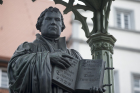
It is all too true that every reader comes to the Bible with a worldview and certain cherished preconceptions. The real question is whether we are willing to submit everything we are, everything we believe, and everything we think to the authority of God's Word. As Martin Luther reminded us, "We are sinners, it is true." We are sinners commanded to bring every thought captive to Christ – not to submit the Bible to our preferred "interpretive trajectory." The last thing the world needs is liberal theologians encouraging sinners to come to the Bible "to make those connections with the hunches they already have."
The Archbishop of Canterbury, who will preside over the October meeting of Anglican primates called in the aftermath of the Episcopal crisis, reads the Bible much like Professor Brueggemann. Rowan Williams has argued that individual texts offer "bids" for truth in the presence of other "bids," and that the interpreter must decide which "bid" will prevail. Here's a hint: Don't bet on Leviticus, Romans, and 1 Corinthians in this bidding process.
Dean Paul Zahl of the Cathedral Church of the Advent in Birmingham, AL [Episcopal], sees right through these arguments. The election of the Episcopal church's openly homosexual bishop "demolishes the Good News of salvation." He continued: "It demolishes salvation because it asserts that what Scripture calls sin is not sin. When there is no sin, there is no judgment. Without judgment, there can be no repentance. Without repentance, there is no forgiveness. The Convention decision fashions a god who is oblivious to sin. It thus denies the redemption of the world to a whole category of persons."
Homosexual activists and their supporting cast of liberal theologians are promoting an "interpretive trajectory" that leads straight to hell. That's not just a hunch.
________________________________________________
R. Albert Mohler, Jr. is president of The Southern Baptist Theological Seminary in Louisville, Kentucky. For more articles and resources by Dr. Mohler, and for information on The Albert Mohler Program, a daily national radio program broadcast on the Salem Radio Network, go to www.albertmohler.com. For information on The Southern Baptist Theological Seminary, go to www.sbts.edu. Send feedback to mail@albertmohler.com. Original Source: www.albertmohler.com.