America's Got Baggage? Approaching A Post-Christian World with Tim Keller, Gabe Lyons
Where do believers stand in a post-Christian America?
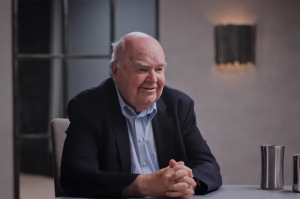
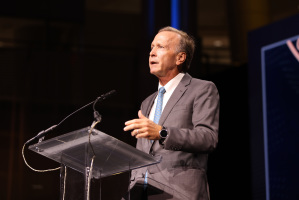
Pastor Tim Keller joined author Gabe Lyons for an exclusive live webcast Thursday afternoon discussing the new opportunities and obstacles that are arising for Christians today in a modern and industrial culture.
No longer under the umbrella of the early church, where faith had once shaped much of the culture and not vice versa, the new generation is witnessing a more multi-dimensional world where different faiths are celebrated, vocational success is rampant, individuality is pushed, and the gospel is becoming increasingly more and more irrelevant.
Both Keller and Lyons, seasoned in their respective fields, proposed their own solutions and perspectives on how to mobilize Christians for the sake of the gospel and approach the church and the world in a fresh way, distinct from the "church of Acts," or the early church.
"My understanding of how you reach a culture is Christians have to be extremely like the people around them, and yet at the same time extremely unlike them," Keller, senior pastor of Redeemer Presbyterian Church in New York City, proposed. "If Christians are not unlike they won't challenge the culture, but if they're not like, they won't persuade the culture. Now, hitting that middle ground is hard."
"Before the coming of Christ believers were culturally different," the Redeemer pastor explained. "Christ comes, and now you can be a Christian in every tongue, tribe, people, and nation. Jesus gets rid of the ceremonial laws and all those things that made Christians culturally strange. In that sense, [now] your neighbor is like you."
Whereas the pre-Christian society differentiated themselves through integrity, generosity, and chastity, the new generation demonstrated "an erosion of ethics" and secularization of culture, stated Keller.
"The difference between a pre-Christian setting is a lot different than a post-Christian world. We're dealing with a lot of baggage here in America," responded Lyons, author of The Next Christians.
"People don't feel like they have a lot of needs – they don't feel 'down and out.' [So] instead of only focusing on the 'down and out,' which can be easy for a lot of churches, how do you start focusing on the 'up and in' – those who have money, who live in the kinds of homes they've always dreamed of living in …"
He continued, "I think this is a new place we have to discover what it looks like to pioneer the gospel going forward in this moment and it's not going to look necessarily like it did pre-Christian years."
One of the "distinctives" of modern America that Lyons mentioned was a sense of purpose – the idea of helping people who culturally struggle with purpose, struggle with coherence to their life story, and engaging them with an idea of calling.
"In an industrial city, work matters so much to so many people. But they are many times doing it without a purpose – they're doing it to make money to keep up. What I think is unique about the Christian calling is understanding that the kind of work and vocations and occupations we take on really do relate to sense some purpose and mission," Lyons detailed.
To which Keller responded, "Maybe we can replace that then. A relativistic culture on the one hand gives you freedom since there are no moral absolutes – that's the upside. The downside is 'what am I here for? If I'm an accident, then I'm not here for a purpose … and I don't have anything to live for.'"
Lyons wondered how churches could be transformed into places that sent people faithfully out into their vocation, instead of simply keeping them in, focused mainly on their vocation within the church.
"There's got to be a balance. On the one hand … traditional Christian marketplace ministries have put all the emphasis on spiritual support, and that's fine and very important," Keller advised.
"But rather than just simply evangelizing, recycling and nurturing people inside their vocation, they ought to be asking 'how does the gospel affect the way in which I do my work, how does it shape my work?'"
Reminding people of their cultural commission, Lyons outlined the need for Christians to fight against things that are broken in every corner of society, every single occupation, and every neighborhood. "Being a Christian is not only making a decision to follow Jesus but it's how we live our life today" like "people who are called instead of just looking at" a job as just a job.
Keller added, "It's some kind of mixture [of faith and deed.] The faith-work integration is a mixture of word and deed."
Practically speaking, Lyons suggested the idea of vocation and calling should be talked about and celebrated within the church as people of different vocations went out and restored their respective places.
"Pastors should get very comfortable, almost weekly, pulling anybody up on your stage or in front of everyone in the congregation and asking them to pray for them and sending them out to the mission field; for somebody who has decided to become a pastor or a church planter, [for] the teacher in the local school who has decided to take on the job of teaching students, [for] the entrepreneur who has created a new way of thinking about business …"
Warning church leaders to avoid catering primarily to nonbelievers, Lyons pressed pastors to encourage their congregants, disciple them, and send them out.
"If they're not equipped to know how to talk to their friends and their neighbors about the gospel then we've done them a disservice," he pointed out.
"The medium is the message in so many ways for people," Lyons further expounded. "So when they show up at church, let's say for an hour and a half, and there isn't time spent talking about the other six days of the week and how people are living it out, then we're really only giving it lip service. It's not just about gathering; it's about six days a week."
Referencing Scripture in direct relation to this idea, Keller pointed to Hebrews 13 where God was pleased with two kinds of sacrifices: sharing what you have with others and praising God, the fruit of the lips.
"There needs to be an intersection between what happens during the week and what happens on Sunday in the gathering," Keller said.
As these believers then become properly equipped to engage in a post-Christian society, Lyons cautioned Christians to be grounded and not distracted.
"There's cultural values like entertaining ourselves, being consumers, being overrun by technology and not really managing it well," he said. "I think these are really relevant ways to be unlike [the world]."
"What food is to the body, Christians [should be] to the world – the idea that we're the soul of the world," Lyons posed.
"The conversations we're having about life in the new setting I think is going to require all of us as church leaders, pastors, to reconsider what does it mean to be a church in this new setting."