Nation's Top Christian Geneticist Defends God and Evolution
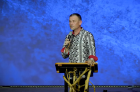
WASHINGTON – No microscope, Petri dish, or buffer was in sight as one of the nation's leading geneticists, Dr. Francis Collins, stepped out of the laboratory and took off his lab coat to assume the role of a Christian apologist under the vaulted ceiling and intricately carved stone wall decorations of the famed Washington National Cathedral.
"So you're a believer and you're a geneticist – doesn't your head explode at this point," joked Collins drawing laughter from the crowd after noting that he became a Christian during medical school at the age of 27.
Collins, the director of the National Human Genome Research Institute at the National Institute of Health, gave a lecture Friday evening on "God and the Genome," reconciling the Bible's creation story with evolution and sharing how science should actually bolster a person's faith instead of dismantling it.
"For me – as a scientist who is a believer [that] doesn't think those things have to be compartmentalized – the exploration of nature and the discovery about good things about the human body becomes not only an exhilaration of personal resort but also becomes a glimpse of God's mind," said Collins.
"In that regard, science can be and should be a form of worship. You meet God in the laboratory and not only in a setting like this."
The geneticist criticized Young Earth creationism – or what he described as the fundamentalist interpretation of creation – which teaches that the Earth and life on Earth were created by a direct action of God relatively recently (about 6,000 years ago). It is held by those Christians who believe that the Hebrew text of Genesis can only mean a literal six (24-hour) day account of creation.
Another variant of the creationist view, Old Earth creationism, while still generally taking the accounts of creation in Genesis more literally than theistic evolution (or evolutionary creationism), is more widely held by Christians and typically more compatible with mainstream scientific thought on the issues of geology, cosmology and the age of the Earth, in comparison to Young Earth creationism.
Collins described the fundamentalist teaching as a "terrible, terrible dilemma" to put people in – especially young scientists – where they can only choose either their faith or science.
He said he counseled many young scientists raised with the "narrow" interpretation that is in complete conflict with science, which asserts the earth as much older than thousands of years and that there is an evolution process.
"There is simply no way to come up with an explanation of the earth being two thousand years old without basically throwing out all the basic principles of cosmology, theology, chemistry, physics and biology," commented Collins excitedly.
Collins explained that he believes evolution is part of God's creation process. He pointed out that as he looks at the Bible's creation process, it is the same as science's evolution process in terms of formation chronology.
"Is evolution really the enemy of faith?" questioned Collins. "I don't think so at all! ... Who are we to say that we wouldn't have done it in quite that way?"
The Christian geneticist argues that God gave man the ability to discover Him through science and that Christians should not feel in any way that God needs to be defended against findings of science.
"Is the God who is the author of all creation threatened by our puny minds," questioned Collins. "Is their belief in God not strong enough that He is the author of all of this? That He is hardly threatened by our discovery of this?"
Collins, who recently debated prominent atheist biologist Richard Dawkins in Time magazine, concluded that people should not confuse the different questions that faith and science answers.
"Faith helps answers different questions. 'Why am I here?' Science isn't going to help you with that one," said Collins. "'What is the meaning of life?' No help from science there, either.
"But aren't those some of the most important questions? 'Why' questions? Science is great at 'how' but science is not good at 'why.'"
Francis S. Collins is recognized for his landmark discoveries of disease genes and successfully leading the effort to complete the Human Genome Project (HGP), a complex multidisciplinary scientific enterprise directed at mapping and sequencing all of the human DNA, and determining aspects of its function. He is the author of the book The Language of God: A Scientist Presents Evidence for Belief and is invited to many settings to defend Christianity in debates about the existence of God and evolution.