Today's Christian News Online - The Christian Post
Then you will know the truth, and the truth will set you free. (JN 8:32)
CP HOME > Society > Politics

Experts Debate Religion's Role in American Democracy

[-] Text [+]

WASHINGTON – Experts in a panel butt heads Tuesday as they debated on how religious engagement in public policy should look in 21st century American democracy against the backdrop of a presidential race, where it’s strange not to talk about one’s faith.

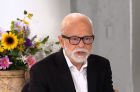
  • (Photo: The Christian Post)
    Dr. David Hollinger - Preston Hotchkis Professor of American History, University of California, Berkeley - speaking at the panel discussion entitled, ''Debating the Divine: Religion in 21st Century American Democracy,'' at the Center for American Progress on Tuesday, June 24, 2008, in Washington, D.C.

The spirited discussion, which often turned intellectually fierce, pitted Dr. David Hollinger, a University of California, Berkeley, professor with expertise in religion and politics in relations to U.S. history, against Dr. Eboo Patel, founder of the Interfaith Youth Core and an expert on the sociology of religion.

Panelists and moderator E.J. Dionne, Jr.,author of Souled Out: Reclaiming Faith & Politics After the Religious Right, readily agreed that religion has an important place in the public square. What they disagreed on is how to integrate diverse religious identities into a common civic life.

Hollinger argues that anyone who proclaims his personal faith as justification for public policy decisions should be ready to defend his religious ideas in public democratic debates.

The UC Berkeley Preston Hotchkis Professor of American History adamantly believes the public has the right to scrutinize and question someone’s religion if he claims it influences choices that affect the public.

“So proclaim your faith, assert its relevance to your political leadership, and then suffer no questions about its soundness,” Hollinger said, referencing former Republican presidential contender Mitt Romney’s speech on his Mormon faith. “Tell but don’t ask? This seems to be our motto today in the public discussion of religious ideas – tell but don’t ask.”

“It will not do to offer religious faith as reason to vote for someone or to support a public policy and then take offense if somebody asks skeptical questions about the basis for it,” he argued.

Hollinger called for “robust public debate” about religious ideas of politicians who invoke their faith to assert public policy decisions.

“One thing that might happen if we did that is that differences would emerge about which religious ideas deserves respect and which did not,” the scholar speculated. “And there might be a quarrel over which religious idea has cognitive plausibility and which did not.”

He pointed to presumptive Democratic presidential nominee Barack Obama and his famous 2006 speech about faith and public policy. The Illinois senator had said “democracy demands that religiously motivated people translate their concerns into universal rather than religion-specific values. Democracy requires that their proposal be subject to argument and amenable to reason.”

Based on this philosophy, Obama reasons that even if he may be opposed to abortion for religious reasons, he cannot pass a law banning abortion because people of other faiths and no faith may not have the same opinion about the practice. Obama believes he can only ban a practice if it violates a universal principle held by all people.

On the other side of the debate was interfaith leader Eboo Patel, who opposes Hollinger’s call for rigorous questioning of politicians’ religious ideas. Instead, Patel, an Indian Muslim, advocates building a pluralistic society where people will respect each other’s differences. Continue >>

 
Pages:Prev12Next

Comments

Most recent comments
  • rolln4him
    Mon Jul 07, 2008 9:28 am : 0 : 0 Flag

    Good viking-

    Unfortunately, you still don't get it. You may actually be surprised that I'd would have agreed to that amendment as well. LOL! But you still aren't getting it.

    Since this debate can rage longer than I'm willing to put into it, we'll just have to part ways and say God Bless AMerica! Way to hang tough, though.

  • viking
    Sun Jul 06, 2008 11:23 am : 0 : 0 Flag

    Rolln4him,
    If the such a clause in the constitution is the evidentiary test that you suggest then I believe you have proved the opposite for the united states since Article VI of the US constitution explicitly prohibits such religious tests of office. Also if you go back and read the notes and records regarding the constitutional congress you will find that this was not lightly done but rather debated at length with specific reference amongst others to the possible elections of Muslims.
    By the way the DelAware Constitution was ammended with the consent of the people in 1792 to remove the religious test.

  • viking
    Sun Jul 06, 2008 11:06 am : 0 : 0 Flag

    wbmoore,
    I have no disagreement with your statement at 8:01. I believe this is reflected in my 11:09pm post. You may note that my presenting of these extensive quotes was in response to rolln4him repeated challenges for evidence to support my earlier statement.
    As stated in my 11:09 post my objection is when people use the "the USA is a Christian Nation" as an excuse or justification for there prejudice and discrimanatory conduct towards members of minority religions. I first made this point in regards to persons on this site suggesting that muslims "go back" to their own country's. I pointed out that many Muslims (and jews, hindus, etc.) were born right here in this country. In fact many of them have Muslim or Jewish ancestors who lived here right in this country going back to pre- revolution times. Some of these ancestors of fought in the revolutionary war for the same rights and freedoms (including religious freedom) that we also enjoy. Also some of these persons are currently serving in the armed services supporting the preservation of our freedoms for the very people who blithely suggest that they go or even be sent back to "their own country" I have to admit it does raise my hackles when I hear that kind of jingoistic , bigoted, prejudice.
    That kind of attitude not only creates division in our civil life and the unity of the country it also in my opinion makes the possibility of such persons accepting the gospel.

  • rolln4him
    Sun Jul 06, 2008 10:04 am : 0 : 0 Flag

    Viking-

    So after reading through the State of Delaware's Contitution of

    "Every person who shall be chosen a member of either house, or appointed to any office or place of trust...shall...make and subscribe the following declaration, to wit: 'I, ______, do profess faith in God the Father, and in Jesus Christ His only Son, and in the Holy Ghost, one God, blessed for evermore; and I do acknowledge the holy scriptures of the Old and New Testament to be given by divine inspiration'"

    I wonder what faith those guys - one was a signer of the US Constitution - had in mind when they pulled this together!?

    You randomly pull out selected quotes and passages to fit your ignorance and neglect to see the overall picture.

  • wbmoore
    Sun Jul 06, 2008 8:01 am : 0 : 0 Flag

    Viking,

    I suspect we could each spend months digging up quotes to support our positions and never convince the other. I found a few quotes to support my position. I know of many more. Yes, a very few of the founding fathers were deists. However, an overwhelming majority were Christian. I believe the number close to 200. Many of them were leaders in their churches. Even at least some of the universalists recognized the principles used for independence were Christian.

    This nation was meant to be pluralistic to allow the free exercise of religion, as understood by the founding fathers. But it was also founded upon Christian principles, to the point where the very institutions created were based upon principles found in the Bible by the founding fathers. The overwhelming majority of the people at that time were Christian. Even the majority of people in this time claim to be Christian. This was a Christian nation in every way but name, and that was to protect the people from the tyranny they had suffered at the hands of government being involved in religion.

  • rolln4him
    Sun Jul 06, 2008 12:58 am : 0 : 0 Flag

    viking -

    OK. We just disagree. I truthfully don't have time to write out an exhaustive survey convincing you of my side. Go to WallBuilders.com as they would do a far better job than I.

    I do recall an interesting bit of the Constitution of the State of Delaware (Article XXII) saying this:

    "Every person who shall be chosen a member of either house, or appointed to any office or place of trust...shall...make and subscribe the following declaration, to wit: 'I, ______, do profess faith in God the Father, and in Jesus Christ His only Son, and in the Holy Ghost, one God, blessed for evermore; and I do acknowledge the holy scriptures of the Old and New Testament to be given by divine inspiration'"

  • viking
    Sat Jul 05, 2008 11:09 pm : 0 : 0 Flag

    On this subject let me add I also recognize that there were many Christian Founders (as well as unitarians, Quakers, Deists, etc.) my point is that (while I fully acknowledge that judeo-Christian principles were embedded within the fabric of our laws) we were founded by definition as a pluralistic nation. I object only when people use the Christian Nation line to justify prejudicial treatment of Americans of other faiths.

  • viking
    Sat Jul 05, 2008 10:52 pm : 0 : 0 Flag

    It was during John Adam's administration in 1797 that the Senate ratified the Treaty of Peace and Friendship, which states in Article XI As the Government of the United States of America is not, in any sense, founded on the Christian religion; as it has in itself no character of enmity against the laws, religion, or tranquillity, of Mussulmen; and, as the said States never entered into any war, or act of hostility against any Mahometan nation, it is declared by the parties, that no pretext arising from religious opinions, shall ever produce an interruption of the harmony existing between the two countries.

    By the way in those days they paid attention to what they were passing On June 7 1797 the treaty including this article was read aloud in its entirety to the whole senate which then approved it UNANIMOUSLY. Following which John Adams signed it.

    In presenting these selected quotes I am not saying I agree with the views of these Founders only reporting what they actually said.

  • viking
    Sat Jul 05, 2008 10:50 pm : 0 : 0 Flag

    Thomas Jefferson, third president and author of the Declaration of Independence, said:"I trust that there is not a young man now living in the United States who will not die a Unitarian." He referred to the Revelation of St. John as "the ravings of a maniac"
    From: Thomas Jefferson, an Intimate History by Fawn M. Brodie, p. 453 (1974, W.W) Norton and Co. Inc. New York, NY) Quoting a letter by TJ to Alexander Smyth Jan 17, 1825, and Thomas Jefferson, Passionate Pilgrim by Alf Mapp Jr., pp. 246 (1991, Madison Books, Lanham, MD) quoting letter by TJ to John Adams, July 5, 1814.

    James Madison, fourth president and father of the Constitution, was not religious in any conventional sense. "Religious bondage shackles and debilitates the mind and unfits it for every noble enterprise."
    "During almost fifteen centuries has the legal establishment of Christianity been on trial. What have been its fruits? More or less in all places, pride and indolence in the Clergy, ignorance and servility in the laity, in both, superstition, bigotry and persecution."
    From: The Madisons by Virginia Moore, P. 43 (1979, McGraw-Hill Co. New York, NY) quoting a letter by JM to William Bradford April 1, 1774, and James Madison, A Biography in his Own Words, edited by Joseph Gardner, p. 93, (1974, Newsweek, New York, NY) Quoting Memorial and Remonstrance against Religious Assessments by JM, June 1785

    Benjamin Franklin stated “As to Jesus of Nazareth, my Opinion of whom you particularly desire, I think the System of Morals and his Religion...has received various corrupting Changes, and I have, with most of the present dissenters in England, some doubts as to his Divinity; tho' it is a question I do not dogmatize upon, having never studied it, and think it needless to busy myself with it now, when I expect soon an opportunity of knowing the Truth with less trouble." He died a month later, and historians consider him, like so many great Americans of his time, to be a Deist, not a Christian.
    From: Benjamin Franklin, A Biography in his Own Words, edited by Thomas Fleming, p. 404, (1972, Newsweek, New York, NY) quoting letter by BF to Exra Stiles March 9, 1970.
    Benjamin Franklin, A Biography in his Own Words, edited by Thomas Fleming, p. 404, (1972, Newsweek, New York, NY) quoting letter by BF to Exra Stiles March 9, 1970.

    Now some might say that the author of the Declaration of Independence, the chief writer of the Constitution, several signers of both documents, and some revolutionary patriots including the 2nd, 3rd and 4th president of the Country don’t really represent founders of the Country. So here is one more piece of historical fact that might have missed your attention.

  • viking
    Sat Jul 05, 2008 10:49 pm : 0 : 0 Flag

    Rolln4him,
    It seems your just not happy unless your picking a fight. Ok for your authority on whether the USA was founded on Christianity as a Christian nation you site Barak Obama , John McCain and the “those outside our country”
    You suggest I am out in left field. Well perhaps so but out in that field are John Adams, Thomas Paine, Thomas Jefferson, James Madison, Ethan Allen, Benjamin Franklin and many other “Founders of the Country. But please don’t take my word for it check it out.

    Thomas Paine was a pamphleteer whose manifestos encouraged the faltering spirits of the country and aided materially in winning the war of Independence:
    I do not believe in the creed professed by the Jewish church, by the Roman church, by the Greek church, by the Turkish church, by the Protestant church, nor by any church that I know of...Each of those churches accuse the other of unbelief; and for my own part, I disbelieve them all."
    From:
    The Age of Reason by Thomas Paine, pp. 8,9 (Republished 1984, Prometheus Books, Buffalo, NY)

    Ethan Allen, whose capture of Fort Ticonderoga while commanding the Green Mountain Boys helped inspire Congress and the country to pursue the War of Independence, said, "That Jesus Christ was not God is evidence from his own words." In the same book, Allen noted that he was generally "denominated a Deist, the reality of which I never disputed, being conscious that I am no Christian." When Allen married Fanny Buchanan, he stopped his own wedding ceremony when the judge asked him if he promised "to live with Fanny Buchanan agreeable to the laws of God." Allen refused to answer until the judge agreed that the God referred to was the God of Nature, and the laws those "written in the great book of nature."
    From:
    Religion of the American Enlightenment by G. Adolph Koch, p. 40 (1968, Thomas Crowell Co., New York, NY.) quoting preface and p. 352 of Reason, the Only Oracle of Man and A Sense of History compiled by American Heritage Press Inc., p. 103 (1985, American Heritage Press, Inc., New York, NY.)

    John Adams, the country's second president, was drawn to the study of law but faced pressure from his father to become a clergyman. He wrote that he found among the lawyers 'noble and gallant achievments" but among the clergy, the "pretended sanctity of some absolute dunces". Late in life he wrote: "Twenty times in the course of my late reading, have I been upon the point of breaking out, "This would be the best of all possible worlds, if there were no religion in it!"
    From:
    The Character of John Adams by Peter Shaw, pp. 17 (1976, North Carolina Press, Chapel Hill, NC) Quoting a letter by JA to Charles Cushing Oct 19, 1756, and John Adams, A Biography in his Own Words, edited by James Peabody, p. 403,

  • viking
    Sat Jul 05, 2008 10:48 pm : 0 : 0 Flag

    series of posts comming

  • rolln4him
    Fri Jul 04, 2008 9:02 pm : 0 : 0 Flag

    wbm and proph-

    No doubt that you all get it, but it sounds viking is playing games or is out in left field o things.

    Have a great 4th and may God bless you! I'm going to watching the fireworks.!!!!! God, I love this nation!!!!

  • Prophet
    Fri Jul 04, 2008 8:19 pm : 0 : 0 Flag

    wbmoore,
    I'm just amazed at the wealth of knowledge that you present to us. I've learned a lot from you.

  • wbmoore
    Fri Jul 04, 2008 8:06 pm : 0 : 0 Flag

    Prophet, I'd have to agree with you.

  • wbmoore
    Fri Jul 04, 2008 7:23 pm : 0 : 0 Flag

    My reading of history shows this country was founded on Christian principles, with the explicit requirement that the government has no right to establish a national religion, nor prohibit the free exercise thereof. However, numerous historical documents recognize that the USA was indeed a Christian nation. Granted, there were numerous denominations, but it was still considered to be a Christian nation none the less.

    President Harry Truman wrote to Pope Pius XII in 1947 that "This is a Christian nation." Certainly he did not mean we had a national religion. He meant that most of the people were Christian, and the institutions and laws of this country were profoundly influenced (founded based upon) by Christian and Jewish principles found in the BIble.

    Woodrow Wilson said the same thing. Samuel Adams, a signer of the declaration of independence, and a supreme court justice, and chief justice of the Maryland supreme court, and a cousin to John Adams, wrote in 1799 "By our form of government, the Christian religion is the established religion... ."

    "Our sixth President, John Quincy Adams said "From the day of the Declaration...they [the American people] were bound by the laws of God, which they all, and by the laws of The Gospel, which they nearly all, acknowledge as the rules of their conduct""

    "John Jay, the first Chief Justice of the US Supreme Court said: "Providence has given to our people the choice of their ruler, and it is the duty, as well as the privilege and interest of our Christian nation to select and prefer Christians for their rulers.""

    quotes from http://www.catholiceducation.org/articles/politics/pg0040.html - and no I am not Catholic.

Please help us to monitor our message boards by flagging Abusive, Spam, Offensive, Illegal, Racist or Libellous Posts.

Comment on this story

Submit

Don't have a Christian Post ID?Signing up is easy. Click Here