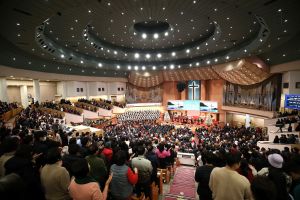
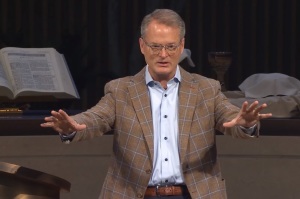
As Christians across California grapple with the legalization of same-sex "marriage," the shock factor at one emerging church remains small.
And it's not because the young and growing church embraces a liberal theology or supports gay "marriage," but because they don't avoid talking about sexuality, including homosexuality.
"In our church, at least from the people I have been hanging out with, I have not yet heard too much 'Oh my gosh, look what happened,'" said Dan Kimball, pastor of Vintage Faith Church in Santa Cruz, Calif., and a well-known emerging church leader who subscribes to a more conservative theology. There wasn't much of a reaction at Vintage Faith to the May 15 court ruling that allowed same-sex couples to wed, he said. Many believed it was inevitable.
And Kimball had more conversations with pastors outside the state who were more curious about the impact of the ruling than those around his church. He believes people at his church were not shocked partly because of their openness in discussing marriage and homosexuality.
At Vintage Faith, they've created a culture of addressing and responding to such issues. Kimball encourages other churches to do the same – to create a culture of teaching the theology of these controversial issues in a way that people can understand and not approaching the issues just at the surface level.
"I hope then people will be able to respond in a healthy way and not [be] reactionary," he said in a recent interview with Skye Jethani, managing editor of Leadership journal.
Kimball is currently teaching out of the New Testament book 1 Corinthians in a series titled "Sin City: Being the light of Jesus in a darkened culture." Early in the series, which launched on June 15, he addressed marriage and human sexuality, teaching the theologically conservative position that marriage is designed for a man and a woman. An open forum followed the sermon last weekend.
While Vintage Faith does not endorse homosexual "marriage" theologically, the church – like any emerging church – is ingrained in the culture, a culture that has becoming increasingly tolerant of the homosexual lifestyle.
"To me, I really believe that if church leaders aren't involved in people ... [who] are gay outside of their church, that needs to happen so that they can just understand [their] lives more," Kimball said in the interview.
"So when they think about [homosexuals], it's not just this population of people that is faceless; they really can think of hearts and minds and eye expressions," he added.
Church leaders need to see every human being, regardless of their sexuality or lifestyle, in the image of God, he stressed.
"That to me is critical because then you respond differently," the emerging pastor said.
Kimball's seven-week "Sin City" series continues on Sunday with a message on "Single Like Jesus." The series aims to help Christians share the way of Jesus in their culture and avoid being consumed by a sin-saturated culture.

DP
All Christians believe the Nicene Creed or they aren't Christians by definition. It has nothing to do with being Catholic since catholic (small c) is the universal church without the Roman Catholic Church claim of the only church.
And your comment, "isn't the term 'emergent' the same as 'coming out of the closet'?" is juvenile at best, a broad brush false accusation which constitutes slander and is a serious sin (false accusation) in Yahweh's eyes. Although I am not emergent and I find much of the Emergent church to be heretical, making adolescent attacks on people is not how we are told we should think and act.
Grace and Peace,
Jim
from the history of Vintage Church(http://www.vintagechurch.org/about/history):
"Vintage Faith Church" (the first formal church plant of Santa Cruz Bible Church, a non-denominational church) merged with "First Presbyterian Church".
The Vintage Church website is http://www.vintagechurch.org/
The doctrinal statement is there. They are apparently Catholic and believe the nicene creed:
http://www.vintagechurch.org/about/theology/truths-in-the-nicene-creed
indy, what several people are sharing is their opposition to the emergent church as opposed to the way this church is choosing to deal with the issue, but I agree Dan Kimball appears to be biblically sound on this issue.
I am confused by the negative comments here. In this article, didn't Dan Kimball clearly state he is conservative theologically on this issue and say that he teaches his church that marriage is for a man and a woman? It states that twice in this article that he believes and teaches that marriage is for a man and woman.
isn't the term 'emergent' the same as 'coming out of the closet'?
"emergents are trying to spin God's Word in a way that hurts Christianity and convince whoever will listen that Bible believers are dumb and intolerant. "
I think its worse than you suggest. I think that at least some emergent leaders are and have said that we need to not focus on eternity, that we should not concern our silly little heads with whether Christ is the substitutionary atonement we need to be with God, but instead focus only on the here and now and only help people with their physical and emotional needs - rather than deal with the cause for those needs, their spiritual need.
Back to the point, emergents are trying to spin God's Word in a way that hurts Christianity and convince whoever will listen that Bible believers are dumb and intolerant. The best gift anyone can recieve is the gift of Salvation through Jesus Sacrifice on the Cross.
Wasn't Brian McLaren a "pastor" emergent of course.
from a recent AP story:
"Meanwhile, Obama's campaign is aggressively reaching out to evangelicals.
The Illinois senator dispatched former 9/11 Commission member Tim Roemer to meet with fellow Roman Catholics. He sent Brian McLaren, one of the country's most influential pastors, to meet with fellow evangelicals. And aides have conducted more than 200 "American Values Forums," soon to be followed up with house parties and town hall-style meetings aimed at young Catholics and young evangelicals."
The point being, of the three very plausible interpretations of 'except for porneia' â
Here's another scholar - Dr. William Heth. In his book Divorce, he states, "The 'except for marital unfaithfulness' clause does not need to mean any more than the fact that divorcing an unchaste wife would not make her an adulteress, for she has made herself an adulteress, adultery being the most common type of sexual offense covered by the term porneia . . . The exception clause in Matthew 5.32 is simply a matter-of-fact recognition that if the wife has already committed adultery, her husband cannot be held guilty of driving her into it by divorcing her . . .
"But immediately following, we find Jesus' absolute and unqualified conditional statement that 'whoever marries a divorced woman commits adultery . . . [which] strongly suggests that Jesus never intended to sanction remarriage after divorce for marital unfaithfulness."
wbmoore,
But I still believe that my posts at 12:02 am, 11:56 am, and 12:13 pm (ignore the lengthy quote at 11:09 am) is very reasonable. The loophole that many Christians hinge their hopes on is the exceptive clause of Matthew, which is not supported by Mark, Luke, or Paul, so it seems reasonable that it have a certain significance to Jews. Many conservative scholars have come to this same conclusion, so I'm not sure why you believe that this position is not adequately supported.
wbmoore,
I apologize that I inserted a lengthy quote where I merely cut and pasted from some evangelical study that I had found. I usually try to use my own words and keep it much shorter.
I,
I went to begin a post in response to what you have written, but I realized what you had posted since I posted my latest response was a page and a half in Word. I appreciate that you have done considerable research to support your position.
However, I still do not think the position is adequately supportable, given what I perceive to be flawed examples and the usage of the word elsewhere.
But due to the obvious effort this would take to refute this theory in your eyes or confirm it in mine, and the fact this is not an important enough issue to me to attempt to type this up and I do not have access to the resources you mentioned at this time, I decided to not continue this discussion at this time.
Recall that when Mary was discovered to be with child by the Holy Spirit, Joseph had in mind to divorce her quietly (Matt. 1:19), yet they were only in the betrothal period. Matthew perhaps had reason to clarify why Joseph's planned course of action was legitimate, given what Jesus said later regarding marriage.
I completely forgot to mention another possible reason for 'except for porneia' being unique to Matthew's gospel. Some scholars have taken it to refer to unchaste behavior before the marriage is consummated; i.e., during the betrothal period. At that point, it is possible to dissolve the marriage, for marriages become indissoluble only when they are consummated. Since this would be relevant in particular to a Jewish audience, this again lends credence to the specific nature that this phrase may have had for Jews, and possibly explain why this exceptive clause is contained in Matthew's gospel and omitted in Mark's and Luke's. If 'except for porneia' merely meant any sort of sexual immorality, then certainly the Greco-Roman world would have needed to know this as well, if not more, than the primarily Jewish community to which Matthew was directing his gospel.