Child survivor of ethnic cleansing finds hope through Christ-centered NGO

METSAMOR, Armenia — At first, the boy from Artsakh drew mostly darkness, a reflection of the trauma tied to the forced displacement of his people three years ago, but after working with a Christ-centered program, the boy has gradually begun to depict the world with more color.
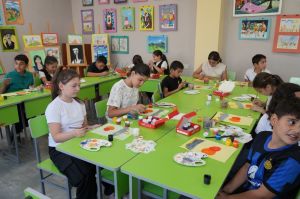
The boy is one of hundreds of children served by Family and Community NGO, which operates centers in Metsamor, Armavir and Artik, Armenia. During a tour of the Metsamor center, Knarik Garanfilyan, the organization's president, presented several of the children's drawings while speaking through a translator.
"He depicts war here; the clouds are black, the sun is black," Garanfilyan said about the child’s drawings.
The boy arrived in Armenia following the forced displacement of the ethnic Armenian population from Nagorno-Karabakh (known as Artsakh to Armenians). Following Azerbaijan's military offensive in September 2023, more than 100,000 ethnic Armenians fled Artsakh for Armenia. An earlier wave of displacement occurred during the Second Nagorno-Karabakh War in 2020, when approximately 90,000 people were displaced to Armenia. Control of the region has been disputed since the collapse of the Soviet Union.
One of the boy's first drawings showed him beside his family's car, with their possessions packed inside as they left their home.
The drawings became part of a record of the child's progress as he worked through what he had experienced. After working with the center for about two years, the child’s drawings changed; the sun in his pictures was no longer black but yellow, and his artwork reflected that he had found a friend.
While the child’s recent artwork shows signs of healing, Garanfilyan pointed out that the drawings suggest scars that have not fully healed yet.
"The problem is that the windows and doors are still black," she explained, adding that "trauma is a slow process to get through."
The president of the center said the NGO sees children arrive carrying difficult stories that are not always visible when they are laughing, playing, singing or drawing. The organization has also seen children continue their education, attend universities, become professionals and build families of their own.
About 350 to 400 children attend Family and Community NGO's three centers each year, she explained.
"The difference between these centers and similar centers that you can find in Armenia is that they work on the basis of Christianity and the rules of the Bible," the translator said on Garanfilyan's behalf.
The center's work is rooted in its understanding of Christ's command to His apostles when they told Him that hungry people had nothing to eat. Instead of sending the people away, Jesus instructed His apostles to find them something to eat.
"That's why this center took the responsibility of taking care of children and their families in order for them to be able to overcome their difficulties," Garanfilyan said.
Another collection of drawings belonged to a boy whose mother had served in the military and was killed by Azeris. After the Azeris returned the woman’s body to Armenia, specialists at the center worked to help prepare him for the reality of her death, including providing psychological support.
The first card he made for his mother after her death was almost entirely black, and his other drawings repeatedly depicted a struggle between good and evil.
But eventually, his pictures began to change, too. More color appeared, including in another card he made for his mother.
The NGO has worked with the Tufenkian Foundation for more than 24 years, which is one of its main supporters. Other supporters include the Ministry of Labor and Social Affairs of RA, and the Diocese of Armavir of the Armenian Apostolic Church.
The organization also works with the broader community, seeking to help families and children become more accepted and included. Garanfilyan described the work as a triangle involving the child, family and community.
Samantha Kamman is a reporter for The Christian Post. She can be reached at: samantha.kamman@christianpost.com. Follow her on Twitter: @Samantha_Kamman