This content is paid for by an advertiser and published by CP Brand Solutions. The Christian Post newsroom was not involved in creating this content. Learn more about CP Brand Solutions.


A mother begins again after fleeing Kyiv to save her child
On a cold February morning before dawn, Daria Khrystenko laced up her running shoes. She didn’t know that, by the time the sun rose in Kyiv, Ukraine, her life would change. She had planned to go for a run — something she didn’t even enjoy, she would later laugh — when a friend called with a message that shattered everything:
“The war has started. I hear shelling.”
Within twenty minutes, Daria packed a small bag, gathered her 10-year ‑old son, Max, and lured her two cats into carriers.
“I had to wake my son and just pack and leave Kyiv,”
she said. The decision was instinctive but agonizing. She knew only one thing with certainty: she had to protect her son.
“I knew we had to leave Kyiv immediately,”
she remembers.
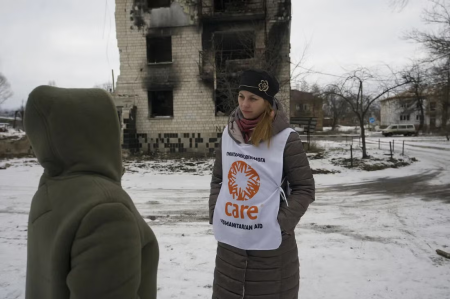
When war broke out in Ukraine in 2022, families like Daria’s were forced to flee their homes with little warning. Poland quickly became a major refuge and 90% of those who arrived early in the war were women, children and the elderly. Thousands of mothers like Daria undertook dangerous journeys for the sake of their children.
At first, Daria believed the need to leave their home in Kyiv would be temporary.
“We were thinking this is not real… we would stay a few days or weeks at my parents’ place and then return home.”
After staying at her parents’ house, Daria was forced to leave again when her mother developed severe heart problems from the stress of the conflict. With her mother and Max in the car, she drove through Romania, Moldova, Slovakia, Hungary and finally toward Poland.
The journey took 11 days. Along the way, her mother’s health deteriorated so severely that they found themselves stranded in a small village hospital where no one spoke Ukrainian or English.
“It was so scary… we were not able to communicate.”
Daria cared for her mother in a place with no internet and no way to get additional support. She drew strength from her determination to get to a safe place where she could speak the language — Poland.
When Daria, Max, her mother, and the cats finally arrived in Warsaw, they had almost nothing, but a miracle awaited them. A friend of a friend — a woman Daria had never met — welcomed them with open arms and kindness. She offered them an apartment, stocked it with food, towels, blankets and essential items.
“She treated us as family,”
Daria said.
In Warsaw, Daria’s immediate priority was Max. She signed her son up for school so he could get back to a routine. After everything they had been through, she wanted him to have some sense of normalcy.
While waiting to pick Max up at the school, Daria overheard a conversation: the principal was searching for an English teacher. She optimistically approached the principal, but learned Ukrainian teachers couldn’t legally work in Polish schools without diploma recognition. The principal had an idea: there was a program hiring Ukrainian teacher assistants.
“That happened to be CARE’s program,”
Daria explained.
CARE, a global poverty-fighting organization, responded quickly when the conflict broke out in Ukraine. Since 2022, CARE’s response in Poland has included housing, food and water, financial assistance, employment opportunities and education support—specifically programs that employ Ukrainian teachers to teach Polish and Ukrainian students in Polish schools.
Daria was quickly hired by the program at CARE and became a bridge between newly arrived Ukrainian children, their families, and the schools. One of her earliest tasks was calming two frightened Ukrainian students who were fighting because teachers couldn’t understand their language. Daria saw firsthand the emotional wounds children carried — fear, confusion and grief — and how much they needed support, culturally and linguistically.
Daria soon joined CARE full-time and is now an Education and Skills Manager supporting the creation of an inclusive and anti‑discriminatory environment in Polish schools. The program operates across the entire country, with more than 150 trained teachers providing support to over 7,500 children.
CARE’s education programs also support Ukrainian children directly. Many teenagers felt especially isolated when taking online classes that were often interrupted by shelling or blackouts. CARE provides catch-up classes in English, mathematics, and Polish alongside mental health and psychological support. The program also prepares students for key milestones: 8th grade state exams and life after school through career orientation sessions. One boy in Gdańsk told Daria that CARE’s program was
“the best thing that happened to him all year”
— because it was the only place he made friends. For Daria, these moments reaffirm her purpose:
“We are at risk of losing a generation… unless we support the children.”
That program now supports more than 360 Ukrainian students in Warsaw, Kraków, and Wrocław.
Today, as Poland hosts nearly 1 million Ukrainian refugees, CARE and its partners in Poland, Romania, Moldova, and Ukraine continue providing shelter, hygiene supplies, mental health care, protection and education — especially for women, children and the elderly.
Four years into the conflict, the numbers are tragic: over 12,000 civilians killed; 3.7 million internally displaced; and 6 million refugees seeking safety abroad. Today, more than 10.8 million Ukrainians need humanitarian assistance.
Despite everything she left behind — the keepsakes and photos, including her grandmother’s faded wedding portrait and the traditional flower crown she cherished — Daria continues to carry her Ukrainian heritage forward. Inspired by memories of her grandmother, Daria organized a traditional Ukrainian flower headdress workshop at CARE that became a much-needed
“celebration of pride and hope”
for Ukrainians in Warsaw.
At home, Daria and Max have created new rituals — evening walks with their cat in the garden — while preserving old ones. Max is thriving in school, speaking Polish confidently, and building friendships.
“I came to Warsaw to build a new life,”
she wrote in a news story for CARE. And she has. Battle-tested, she has built a new beginning rooted in hope and dedicated herself to helping others.
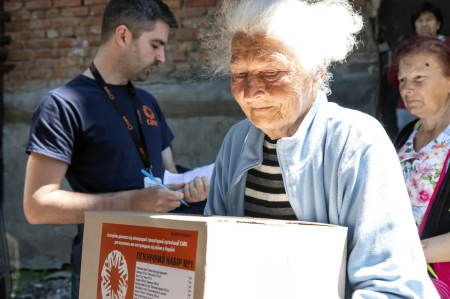
80 YEARS OF NEW BEGINNINGS AT CARE
Since 1946, CARE has been there for families in need — from the aftermath of World War II to the crises of today. As of 2026, more than 117 million people around the world have been displaced. Conflict and extreme weather have created the largest refugee crisis in modern history.
CARE remains on the frontlines, supporting displaced families from Ukraine, Lebanon, Sudan, Somalia, Venezuela and far beyond. Wherever families are seeking safety, kindness, and a chance for a new beginning, CARE is there.
Join us in opening the door for families seeking safety. Stand with refugees. Stand with CARE.