Voting Rights Act doomsayers were wrong. Give thanks.

In late April, the U.S. Supreme Court issued its decision in Louisiana v. Callais. Writing for a six-justice majority, Justice Samuel Alito adopted a narrow interpretation of Section 2 of the 1965 Voting Rights Act, writing for the majority that Louisiana's intentional creation of a second majority-black congressional district amounted to an "unconstitutional racial gerrymander."
Alito and the majority argued that “vast social change” in the South warranted narrowing Section 2 of the Voting Rights Act, ruling that Louisiana's set-aside black-majority district was not required by federal law and constituted an “unconstitutional racial gerrymander.”
The liberal media commentariat went berserk, decrying the decision as an unmitigated catastrophe. In her dissent, Justice Elena Kagan declared that the decision signaled the conservative majority’s “now-completed demolition of the Voting Rights Act.”
In fact, with Callais, the Roberts Court continued Chief Justice John Roberts’ long crusade to guide America, as George Washington University law professor Jonathan Turley said, “toward a colorblind system of laws [...] Roberts holds the quaint idea that when the drafters of the 14th Amendment barred discrimination on the basis of race, they meant it.”
Roberts has been an implacable opponent of quotas, “set aside” programs and reverse discrimination. One of his best-known lines is that “the way to stop discrimination on the basis of race is to stop discriminating on the basis of race,” which he wrote while decrying a policy that sought to discriminate against one group in favor of another.
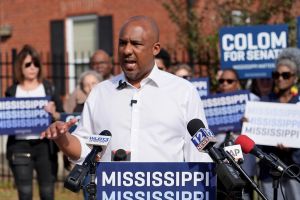
One of the things we can be thankful for as Americans this Thanksgiving is that the doomsayers were utterly wrong. At last count, there were 61 black members in the new U.S. House, compared with 63 in the last House — though gains in the Senate kept total black representation across Congress steady. In addition, Mississippi elected Scott Colom, its first black senator since Reconstruction, and Georgia elected a black woman, Keisha Lance Bottoms, as governor. Florida also elected a black Republican, Byron Donalds, as governor.
It is also now clear that Hakeem Jeffries, D-N.Y., is in line to become the first African American Speaker of the House.
As Jason Riley, the esteemed black columnist for The Wall Street Journal, asked this week, “If ‘Systemic Racism’ is Real, How did Scott Colom Win?” Riley cites a Brookings Institution report that “in the current Congress, ‘only eight out of the 61 black House members were elected from majority black districts.’”
The reality is that, despite truly significant progress on racial reconciliation, some in the liberal media persist in labeling America as systemically racist.
Let’s remember that Barack Obama was twice elected president of the United States in what is still a majority-white country, and that some of the states he won were among those with the lowest percentage of black voters: Iowa, Maine, New Hampshire, Ohio and Vermont. As Riley further points out, even in states Obama lost, such as Georgia, South Carolina and Texas, he received more white votes than Al Gore in 2000 and John Kerry in 2004.
This Thanksgiving, we should give thanks for the real racial reconciliation that has taken place in America and express gratitude for the millions of Americans of all ethnicities who have worked tirelessly to bring it about. I pray that all Americans of goodwill will rededicate themselves to even greater racial reconciliation as we chase the Rev. Martin Luther King Jr.’s dream of a nation where people “will not be judged by the color of their skin but by the content of their character.”
Dr. Richard Land, BA (Princeton, magna cum laude); D.Phil. (Oxford); Th.M (New Orleans Seminary). Dr. Land served as President of Southern Evangelical Seminary from July 2013 until July 2021. Upon his retirement, he was honored as President Emeritus and he continues to serve as an Adjunct Professor of Theology & Ethics. Dr. Land previously served as President of the Southern Baptist Convention's Ethics & Religious Liberty Commission (1988-2013) where he was also honored as President Emeritus upon his retirement. Dr. Land has also served as an Executive Editor and columnist for The Christian Post since 2011.
Dr. Land explores many timely and critical topics in his daily radio feature, “Bringing Every Thought Captive,” and in his weekly column for CP.