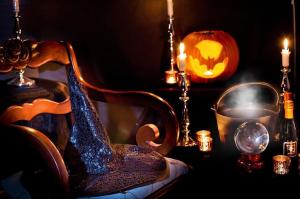
Boo! Haunted houses aren’t real, but …

Well, it’s October, and Halloween is right around the corner, which means I’ll be eating more 3 Musketeers bars (my favorite candy) than usual and taking in a few scary movies with my oldest daughter, who is a horror movie buff. And from what I’m seeing, there’s lots to choose from.
By my last count, there are 1,290,432 paranormal reality shows that are on cable or one of the streaming services. The sheer volume of these series tells us there is great interest in the supernatural, which isn’t surprising given that the share of Americans who identify as nonreligious has declined for three years in a row from 2022 to 2025, and most people believe, in one way or another, that something exists beyond this physical life.
As G. K. Chesterton notes in his book The Everlasting Man: “Nature is always looking for the supernatural.”
But have you ever asked yourself what’s really happening in all these episodes where the show participants are claiming encounters with the paranormal?
The first possibility is sheer fraud: it’s fake, and they know it’s fake. Admittedly, there’s endless history of shysters and scammers conning people with their claims of contacting the supernatural and making big money from it.
The next option is delusion: it’s fake, but they think it’s real. True believers in a particular worldview can talk themselves into all kinds of things and misinterpret even the simplest of occurrences as confirmation for what they want to be true. Skeptics of Christianity throw this possibility at our door every day.
A third prospect is entertainment-only. The events portrayed are dramatized for the viewers in tongue-in-cheek fashion, with everyone involved knowing it’s not real.
The final option is that what’s being experienced and portrayed is genuine paranormal activity: it’s real, and those involved believe it’s real. Though rare, I don’t doubt this occurs. In fact, I had a legit encounter happen to me a long time ago.
One night when I was 6 years old, my mother brought out a Ouija Board for my younger nephew and me to play with. She gave us the gist of how it was supposed to operate, and we went to town trying to get it to work.
It wasn’t long before we started telling all the adults in the living room that the planchette/pointer was moving on its own. Of course, no one believed us, especially my much older sister (my nephew’s mother), who was fresh out of graduating from Michigan State and a skeptic of pretty much everything.
My nephew and I kept saying the planchette was moving without us pushing it, and my sister had finally had enough. “OK,” she said, “spell Czechoslovakia.”
And we did. Or, rather, the planchette did.
Pregnant pause. Pin-drop silence.
Clearly that word was far above my nephew’s and my education level, as was every other complicated word she and the other adults in the room threw at us. And we batted a thousand, each time spelling out what was requested.
So, how do you explain that? If you’re a naturalist/materialist and don’t believe in anything beyond the physical, it becomes especially hard to identify a cause behind two preschoolers being able to spell out very sophisticated words on a board of letters.
But if you’re not going to limit yourself to a material-only cause, then the simplest explanation is that there was a noncorporeal, intelligent entity present who was able to insert itself into the physical world and manipulate things. That’s what those producing paranormal shows claim all the time.
But if that’s really the case, what’s the true nature of those immaterial entities? A ghost? A poltergeist?
Or something much worse?
The haunting of Bishop Pike
If he were still alive, Merrill Unger would have no trouble telling you his opinion on the matter. Unger, who, for years, was a worldwide respected theologian who taught at Dallas Theological Seminary, was an expert in (among other things) demonology and an author of several books on the subject.
One of his works was a little book titled The Haunting of Bishop Pike that chronicled the tragic story of a controversial Episcopal Bishop who had the kind of valid supernatural encounters that most ghost-hunters dream of.
In the book, Unger describes how, on Feb. 4, 1966, the Bishop’s 20-year-old son died by suicide in a New York City hotel room. Shortly afterward, the bishop began experiencing poltergeist-style activity in the Cambridge flat where he and his son had lived. Many people witnessed the unexplained activities, including the Rev. David Barr and Maren Bergrud of the Episcopal Diocese of California, who occupied the flat with the bishop.
Pike, who had previously disbelieved in life after death, became convinced that his deceased son was trying to communicate with him from beyond the grave. The various phenomena that occurred in the residence had the “signature” of his dead son and relayed information in a way that only the younger Pike would know.
Moved by the remarkable activities he was seeing with his own eyes, the bishop began visiting a number of mediums in an attempt to communicate with his son. While fraud and failure are the norms in the psychic domain, the bishop experienced actual “success” and obtained communications that, again, only his son would know.
A result of the bishop’s experience was him authoring a book titled The Other Side that chronicled his paranormal experiences and newfound occultic faith in the hereafter. The question, of course, is what really happened in his case?
In his book, Unger argues the bishop was deceived by what the Bible calls angels of light (2 Cor. 11:14):
The essential thing to understand concerning all the phenomena of spiritualism, whether telekinesis, psychic visions, automatic writing, trance speaking, materializations, apparitions, excursions of the psyche, or whatever is that fact is used as a springboard to fraud … Satan’s masquerading as an angel of light is far more destructive than his forays as a devouring lion.
Pike lacked the discernment to understand such a thing — that the spirit interactions he was encountering were anything but the holy kind. Unger says: “Bishop Pike was unable to evaluate his psychic experiences properly and to react wisely because he had rejected the Word of God as authoritative and final.”
Scripture tells us that ghosts and other supposed paranormal entities aren’t real, and that anything that mimics such things is demonic and has only one end goal in mind: the destruction of their human target.
Tragically, this came true for Bishop Pike. He was found dead in a desert by the Dead Sea on Sept. 7, 1969, having succumbed to the elements. Why he was out there and met the end that he did is something no one has ever explained.
Unger sums up the sad end of the bishop when he says the type of supernatural encounters that come “through demonic power are not free and purely beneficent. They always operate under the principle of compensation, with a price tag attached to them … [And that] price must be paid throughout eternity.”
That being true, the real danger of the legitimate paranormal is not that you and I might encounter something we can’t explain. It’s instead that we might confront something we can’t properly discern until it’s too late.
Robin Schumacher is an accomplished software executive and Christian apologist who has written many articles, authored and contributed to several Christian books, appeared on nationally syndicated radio programs, and presented at apologetic events. He holds a BS in Business, Master's in Christian apologetics and a Ph.D. in New Testament. His latest book is, A Confident Faith: Winning people to Christ with the apologetics of the Apostle Paul.