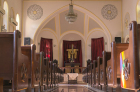
Is reclaiming America's Mainline churches a lost cause?

In 1960, approximately 45% of all Americans were members of the Mainline Protestant denominations (Episcopal, Methodist, Northern Baptist, United Church of Christ, Congregational Presbyterian, and non-Missouri Synod Lutheran). The collective membership of these denominations made up the Protestant “establishment,” and their membership dwarfed the Evangelicals (Southern Baptist, Independent Baptist, and those who left the Mainline denominations during the fundamentalist-modernist controversy in the 1920s and 1930s). For example, both the General Association of Regular Baptists (GARB) and the Conservative Baptists broke off from the Northern Baptist Convention in 1932 and 1944, respectively.
The Mainline denominations held tremendous sway in American culture, as the Evangelicals had lost influence in their various denominations and the Roman Catholics were at least a generation away from not being too “ethnic” to claim the cultural high ground. The historical black churches tended to be liberal on social policy and conservative on theology.
As American society moved through the 1960s and 1970s, the Mainline Protestant establishment churches began to increasingly resemble the American Civil Liberties Union (ACLU) at prayer. As the years progressed, the Mainline churches continued to lose membership and influence as Evangelicals and Roman Catholics grew. Today, Mainline Protestant denominational membership contains about 13% of Americans.
The theological division became so severe that the conservative Presbyterian Church in America (PCA) broke off from the Presbyterian Church (USA), or PCUSA, and the more Evangelical Global Methodists (about 40%) broke off from the United Methodists beginning in 2024.
In my own denomination, the Southern Baptist Convention, a grassroots Conservative Resurgence beginning in the late 1970s successfully addressed a liberal drift in Southern Baptist institutions and reasserted its thoroughly Evangelical convictions. Dr. Nancy Ammerman’s book Baptist Battles (1995), which grew out of her Emory University Ph.D. dissertation, documents the extent to which Southern Baptist educational institutions had drifted away from the conservative beliefs of the Convention’s church members before the Convention’s membership brought them back in line with Southern Baptists’ historic conservative, Evangelical beliefs.
While I rejoice at the victories over theological liberalism in Southern Baptist life, I have agonized with many Methodist and Presbyterian friends as they tried for so many years, unsuccessfully, to revitalize their Methodist and Presbyterian churches.
Just recently, I was reminded once again of these struggles as I read Alex Hibbs discuss attempts to bring Mainline Protestantism back to orthodoxy in "The Reconquest of Mainline Protestantism."
The liberalization of the Mainline (now the “sideline”) denominations continues. The Presbyterians (PCUSA) have just declared their support for trans surgeries for minors. It is not surprising that membership continues to decline.
Earnest young Christian conservatives like Alex Hibbs want to reclaim their denomination and their churches for the Gospel. The question is, can they do it? Possibly, because with God, all things are possible.
With God, all things are indeed possible, but the truth is that the liberal former Mainline denominations have structures that make it very difficult for conservative ministers to be ordained and approved by the denomination, and for conservative congregations to call them as their pastors. Just recently, the United Methodists (the liberal Mainline) removed Asbury Theological Seminary in Kentucky — the only major conservative source of Methodist ministers — from the list of approved seminaries from which Methodist pastors could be chosen.
Looking back on it, the main reason Southern Baptists were able to take their denominational hierarchy back from moderates — beside the fact that 90% of the membership believed in the inerrancy of the Bible, according to Ammerman’s polling — was that each local church called its own pastor and each church decided how much money it would give to the denomination each year. If the SBC had had the same polity as the Methodists, the Presbyterians, or the Episcopalians, the Conservative Resurgence would have failed, and we would have had a division much like the Methodists have just experienced.
I was reminded of this as I read a recent letter to the editor titled “The Liberal Hijacking of Mainline Churches” in The Wall Street Journal.
“I spent more than two decades fighting, in internal courts and governing bodies, the slide to the left of the Presbyterian Church (USA). Since then, I have helped many conservative congregations in liberal denominations leave for more orthodox denominations.
One thing I became familiar with was the ordination process in these denominations, particularly in the Presbyterian Church (USA). It isn’t as simple as going to seminary, getting a degree and receiving a call from a congregation. Candidates must be approved by the presbytery—a denominational subdivision usually controlled by liberal pastors. My former presbytery would waive through prospective pastors who doubted Jesus’ divinity but gave a hard time to conservative candidates.
This will only get worse. Liberals, who control the mainline institutions, will simply block the large-scale ordination of orthodox pastors, as they must if they want to keep control of their institutions and property. Conservative pastors should make it their mission to lead people to the Messiah, rather than seeking to control these exhausted institutions.”
Whitman A. Brisky
Chicago
As I stated earlier, Southern Baptist ordination takes place at the local church level, so liberals and moderates could not suppress conservative pastors from being ordained and called as pastors of churches.
In addition, the local churches elected messengers to the annual Conventions, which approve trustees nominated by the elected president every year, so there were no self-perpetuating trustees of institutions. How this was done and how it played out historically is summarized in Jerry Sutton’s The Baptist Reformation (2000).
In the Mainline denominations, a very entrenched liberal and self-perpetuating bureaucracy is adamantly opposed to conservative reformation. I fear that younger conservatives who find themselves trapped in such denominations would be better off seeking to minister to more like-minded believers, and to evangelize and disciple through them.
Dr. Richard Land, BA (Princeton, magna cum laude); D.Phil. (Oxford); Th.M (New Orleans Seminary). Dr. Land served as President of Southern Evangelical Seminary from July 2013 until July 2021. Upon his retirement, he was honored as President Emeritus and he continues to serve as an Adjunct Professor of Theology & Ethics. Dr. Land previously served as President of the Southern Baptist Convention's Ethics & Religious Liberty Commission (1988-2013) where he was also honored as President Emeritus upon his retirement. Dr. Land has also served as an Executive Editor and columnist for The Christian Post since 2011.
Dr. Land explores many timely and critical topics in his daily radio feature, “Bringing Every Thought Captive,” and in his weekly column for CP.