The cross of Jesus still puts broken lives back together

On Good Friday, we are invited to look again at the cross — not casually, not from a distance, and not merely as a symbol. The cross is where everything broken in humanity meets the restoring power of God.
Most of us are used to viewing the crucifixion from the ground up. The Gospel writers describe the scene: Jesus in the middle, thieves on both sides, religious leaders mocking, disciples fleeing in fear. It looks like a loss. It looks like defeat.
But elsewhere in Scripture, another picture is painted.
David, writing prophetically in Psalm 22, takes us inside the suffering of Christ. He describes the agony in such detail. He writes of bulls rushing Him, of wild dogs devouring Him — language that captures the brutality of the moment. There were no literal wild dogs, but the pain of the cat-of-nine-tails, the nails in His hands and feet, and the spear in His side made it feel that way. This was not symbolic suffering. This was real agony, endured for us.
In the middle of that suffering, a powerful moment unfolds. One thief on a neighboring cross mocks Jesus. But the other sees him for who He is.
He looks at a beaten, bleeding man crowned with thorns and still says, “Lord.” He sees what others cannot. “You don’t look like a king,” the scene seems to say, “but you are a King.” A King with nails in His hands. A King who is dying, yet reigning.
And then that thief makes an extraordinary request: “Remember me when You come into Your kingdom.”
That word remember is deeper than we often realize. It does not simply mean to think about someone. In its original sense, it means the opposite of dismember. It means to put back together what has been torn apart.
In essence, that thief was saying, “This cross and this life have dismembered me. Sin has torn me to pieces. I have been separated from everything good. When You come into Your Kingdom, put me back together.”
Jesus answers him with amazing grace: “Today you will be with Me in paradise.”
In that moment, Jesus was declaring the purpose of the cross. What sin dismembered, He came to restore. What had been separated, He would reunite.
Go back to Eden and you will see what humanity once was — bone of His bone, flesh of His flesh, walking with God in the cool of the day. But sin came, and it dismembered that relationship. Humanity was separated from God, and the story seemed to end with a flaming sword guarding the way back.
But the cross is God’s answer to that separation.
At Calvary, Jesus allowed His body to be broken and His blood to be poured out. Scripture teaches that the life of the flesh is in the blood. When blood is separated from the body, death occurs. Jesus was, in every sense, dismembered for us.
And yet, through that sacrifice, He made a way for us to be remembered. This is why communion is so powerful.
When we come to the table, we take two elements: the bread, which represents His body, and the cup, which represents His blood. On the cross, the separation of His blood from His body brought death. But when we receive the bread and the cup together, we are declaring life.
We are saying, “Lord, what has been torn apart in me, put it back together.”
Through His body and His blood, there is forgiveness of sin. There is healing for the body. There is deliverance from bondage.
This is not just doctrine. It is deeply personal.
There are people today who feel dismembered by life. You may feel like something has torn your life apart. Maybe it is something done to you or something you have done. You may feel separated from God, from peace, and from hope.
But here is the truth of the cross: Jesus still remembers. He still puts lives back together. Just as surely as He spoke to that thief, He speaks to us today.
That is the power of grace. It meets us right where we are. It does not require us to clean ourselves up first. It restores us.
So, when you come to the cross, or when you come to the communion table, ask yourself honestly, “Is there any area of my life that feels torn apart?”
Because the answer is found in Him.
Broken things do not have to stay broken.
Through the cross, they are remembered. They are restored. They are redeemed.
That is why the cross still matters today.
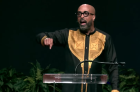
Pastor Jentezen Franklin is the senior pastor of Free Chapel, a multi-campus church. Each week, his television program, Kingdom Connection, is broadcast on major networks all over the world. A New York Times best-selling author, Franklin has written eight books.