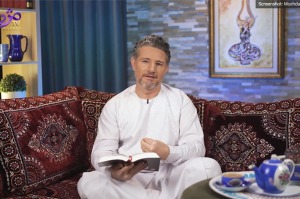
'I can't sleep at night': Former Armenian captive shares what he endured in Azerbaijan

YEREVAN, Armenia — An Armenian aid worker who spent five years imprisoned in Azerbaijan says he holds no resentment toward the men who captured and beat him. Instead, he wants to focus attention on the suffering of those still held captive.
Gevorg Sujyan shared his testimony alongside two refugees from Artsakh, the Armenian name for the contested Nagorno-Karabakh region that was fully taken over by Azerbaijan in 2023, before a delegation of journalists and influencers. The meeting was organized by Save Armenia, a United States-based nonprofit that mobilizes Americans to advocate for Armenia, the world’s first Christian nation.
The Center for Truth and Justice, a nonprofit that collects firsthand testimony from war survivors and victims of atrocities, arranged for Sujyan to speak to the delegation.
“I am here not to talk about politics, nor I am here to spread Azerbaijani phobia among you, because I don’t have any resentment feelings towards those who have captured me and subjected to heavy beatings,” Sujyan said through a translator. “But I want to tell you the truth.”
Sujyan was one of four Armenian prisoners Azerbaijan released in a prisoner exchange in January. He returned to Armenia on Jan. 14 with Davit Davtyan, Vicken Euljekjian and Vagif Khachatryan. In exchange, Armenia handed over two Syrian nationals who had been convicted of fighting as mercenaries for Azerbaijan during the 2020 Nagorno-Karabakh war.
“I am here in freedom, but in reality that’s not really a freedom because I cannot sleep at night; I cannot live my normal life while I know that the other Armenians are still there and are being subjected to what I have been subjected for that long,” Sujyan said.
Sujyan founded the New Armenia Homeland-Diaspora charitable nongovernmental organization. He was captured on Nov. 11, 2020, while traveling to deliver humanitarian aid to Nagorno-Karabakh. Two days earlier, the leaders of Azerbaijan, Armenia and Russia had signed a ceasefire agreement ending the 44-day war.
Sujyan said he wore a badge identifying him as a representative of a charitable organization, but it did not prevent his capture.
He said the Azerbaijani soldiers who seized him first wanted to kill him by beheading him with a knife. Their commander stopped them and ordered that Sujyan be taken to Baku, Azerbaijan’s capital, to have his fate decided.
Sujyan said the commander’s intervention happened “by God’s blessing.”
The journey to Baku took at least seven days, he said, adding that he was beaten severely along the way. An Azerbaijani court later sentenced him to 15 years in prison.
He said that for the first two and a half months of his captivity, his captors told him he was considered missing. They threatened to keep him listed among the missing unless he agreed to let them take photos and publish a video message online confirming his capture.
“And every day, I was told that my family was looking for my corpse,” he said.
To help the delegates understand how the prisoners were treated, Sujyan asked them to imagine being confined in an 8-square-meter (about 86-square-foot) cell, day after day, with nothing changing.
“I had no hope that I would survive, so I was not even thinking about my survival,” he said. “What I was worried about was my family.”
He prayed that, at the very least, his body would somehow make its way home so his family could know what had happened to him.
Now, after his release, that experience is part of the reason he feels compelled to speak.
“I want people to know what feelings I had, what feelings those Armenians had, so that no one in the world experiences what we have experienced or what my colleagues are experiencing now in Baku,” Sujyan said.
Sujyan acknowledged that many people talk about human rights and the importance of protecting them. But he said words alone do not prevent suffering or stop human lives from being used as bargaining tools.
Azerbaijan is still holding 19 Armenian prisoners. As of September 2026, 191 people remain officially missing from the 2020 war, Armenia’s Investigative Committee reports.
“When we talk about numbers, we have to remember that every number is a name, a surname,” Sujyan said. “A person who has a mother, father, a family, maybe kids.”
He said the relatives of the captives are living through a “total nightmare,” not knowing how their loved ones are doing or whether they can do anything to help them.
Sujyan’s message was ultimately a call to act. He asked the delegates to share what they had heard so others would understand what those still detained are going through.
“I really hope that every one of you sitting here will do, will have this tiny contribution even,” he said. “I think together it will serve the purpose of helping someone who is not free yet.”
Following Azerbaijan's military offensive in September 2023, more than 100,000 ethnic Armenians fled their homes in Nagorno-Karabakh for Armenia. An earlier wave of displacement occurred during the Second Nagorno-Karabakh War in 2020, when approximately 90,000 people were displaced to Armenia. Control of the region had been disputed since the collapse of the Soviet Union.
Samantha Kamman is a reporter for The Christian Post. She can be reached at: samantha.kamman@christianpost.com. Follow her on Twitter: @Samantha_Kamman