

Franklin Graham delivers televised Easter message from Minneapolis: 'What is Truth?'

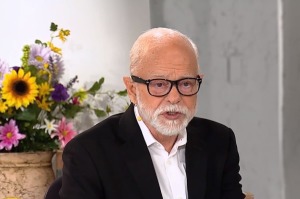
Evangelist Franklin Graham delivered a nationally televised Easter message from Minneapolis on Sunday, choosing a city marked by civil unrest as the setting for a 30-minute program, titled “What is Truth?”
The program aired on several national television networks and more than 100 local stations in markets throughout the United States, the Billy Graham Evangelistic Association said. Apart from the message, it featured music from Michael W. Smith and the late Johnny Cash and Charlie Daniels.
Graham built his message around the question Roman governor Pontius Pilate posed to Jesus before his crucifixion, connecting it to the difficulty of knowing what is true in an era of artificial intelligence.
“In our world today, it’s hard to know what is true,” Graham said. “But I can tell you right now what is true and it’s God’s Word, the Bible. God’s Word is true from cover to cover, every word is totally true.”
To make his point, Graham cited two recent examples of AI-generated content. A fabricated photograph of Graham in a hospital bed had circulated on social media, prompting followers to pray for him in the belief he was seriously ill. A separate AI-generated video depicted President Donald Trump ice skating with the U.S. men’s Olympic hockey team, appearing to score goals in a gold medal match against Canada.
Graham said both postings were fabricated.
Minneapolis was chosen as the filming location in part because of its long association with the BGEA, which kept its headquarters in the city for more than 40 years. The program was filmed at the University of Northwestern, where Franklin Graham’s father, Billy Graham, once served as president.
The city and state have been unsettled in recent months amid protests over U.S. Immigration and Customs Enforcement operations. More scrutiny came following the January deaths of Renee Nicole Good and Alex Pretti during altercations with law enforcement agents in Minneapolis.
In January, a group of protesters stormed Cities Church in St. Paul to protest the fact that one of its pastors also serves as a leader in a local ICE field office. The Department of Justice has charged dozens of people alleged to have been involved in the Cities Church protests.
Graham addressed the unrest directly.
“It’s hard to understand the depth to which our country has fallen,” he said. “The hatred, the violence, the crime, it’s rampant. It seems like the whole world is in conflict. In this time of division, many are wondering, where can we find truth?”
He answered by quoting what Jesus told his disciples. “I am the way, the truth, and the life. No man comes to the Father except through Me.”
Sin, Graham told viewers, stands as a gulf between all people and God, a condition only the crucifixion and resurrection of Jesus Christ could resolve. He quoted the Gospel of John, saying, “God so loved the world that He gave His only begotten Son, that whosoever believeth in Him should not perish but should have everlasting life.”
He called the Roman cross “the most horrible death someone could die” and noted that victims sometimes hung for days before dying of suffocation. Jesus, he said, “stepped out of that tomb alive” on the third day after his burial, with wounds his disciples could physically touch as proof.
Graham also drew on the encounter between Pilate and Jesus to address contemporary skepticism.
“Pilate, nor the world, recognized Him as the truth,” he said. “And many today in the world do not recognize Him. They mock Him, they ridicule Him, and they mock those that follow Him.”
He noted that even Pilate’s wife had warned her husband in a dream to have nothing to do with Jesus, a warning Pilate set aside when the crowd demanded the crucifixion.
Graham pressed his audience toward a personal decision. “You don’t want to ‘think so,’” he said, asking whether viewers believed their sins were forgiven. “You want to know it. You want to have that assurance. You want to be absolutely positive that your sins are forgiven.”
He continued, “This Easter, let me ask the question: Do you know Jesus Christ? Have you surrendered your life to Him? Are your sins forgiven?”
“You can do that right now by just simply, in your heart, just simply saying, ‘God, I’m a sinner. I’m sorry, forgive me. And I believe that Jesus is Your Son. I believe that He took my sins, that He died in my place, and I want to trust Him as my Savior. I want to invite Him to come into my heart, take control of my life, for the rest of my life.’”