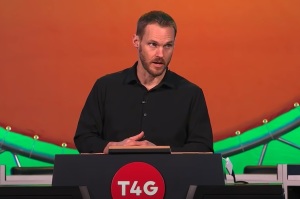
Lawsuit alleging Gateway Church, Robert Morris misappropriated tithes dismissed


A federal judge has dismissed a class-action lawsuit accusing Gateway Church and its former leaders of misusing millions of dollars in donations, ruling that the First Amendment bars civil courts from deciding disputes over how churches manage and distribute charitable funds.
U.S. District Judge Amos L. Mazzant dismissed the lawsuit Tuesday under the ecclesiastical abstention doctrine, which generally prevents courts from intervening in matters of church governance and internal religious affairs.
The ruling comes more than six months after lawyers for the Southlake, Texas-based megachurch asked the U.S. District Court for the Eastern District of Texas, Sherman Division, to dismiss the case for lack of subject-matter jurisdiction.
“In sum, the Court agrees with Defendants that resolving Plaintiffs’ claims will require the Court to conduct an inquiry into the ‘internal management decisions that are essential to the institution’s central mission’ — specifically, whether Gateway has properly allocated its funds from one charitable organization over another — which the Fifth Circuit has forbidden,” Mazzant wrote in his opinion ordering the case closed on Tuesday.
In their amended complaint, initially filed in October 2024, Gateway Church members Katherine Leach, Garry K. Leach, Mark Browder, Terri Browder, and those similarly situated (former Gateway Church members and tithers), accused Gateway Church, its founder Robert Morris, and founding elder Steve Dulin of violating the Racketeer Influenced and Corrupt Organizations (RICO) Act of 1970.
The church members accused Morris and Dulin, in their individual capacities, of fraud and intentional and negligent misrepresentation. They alleged that the defendants persuaded them and others to donate to the ministry by stating that 15% of their donations would go toward global missions and Jewish ministry partners. They say Gateway Church and Morris, who resigned in June 2024, guaranteed they could get a refund of their donations if they were dissatisfied with how the church allocated the funds.

Among other things, the lawsuit alleged that they haven't been able to substantiate the church's use of donations through transparent accounting. Both Gateway Church and Morris denied the allegations and asked the court to dismiss the church members' lawsuit, with support from First Liberty Institute, which filed an amicus brief. Mazzant rejected those earlier motions.
Mazzant previously denied Gateway’s motion to dismiss the lawsuit without prejudice and stated that the defendants could refile their motion to dismiss on this point "once the record is better developed."
In their updated motion to dismiss the church members' case last November, attorneys for Gateway Church pointed to McRaney v. North American Mission Board of the Southern Baptist Convention. The September 2025 5th U.S. Circuit Court of Appeals decision upheld the dismissal of a lawsuit filed by ordained minister Will McRaney against the North American Mission Board.
The court ruled that the ecclesiastical abstention doctrine barred McRaney's claims for defamation and intentional interference with business relationships because resolving them would require a court to rule on "matters of faith and doctrine" and church internal management decisions.
In his opinion, Mazzant said the defendants made it clear in their updated motion to dismiss that the court couldn't rule on the case despite agreeing that the plaintiffs were trying to address the non-religious conduct of the defendants.
“The Court agrees that McRaney must inform its analysis this time around. McRaney is binding on the Court and the Fifth Circuit has put it simply: ‘[c]ivil courts cannot adjudicate ecclesiastical matters,’” Mazzant wrote.
“Although the Court agrees with Plaintiffs that, on the face of the second amended complaint, their claims seemingly address Defendants’ non-religious conduct, this conduct centers around the allocation of tithing dollars to Gateway’s ‘many charitable purposes,’” he explained.
“As such, while both parties acknowledge Plaintiffs’ claims are grounded in traditional civil law, resolving the claims would require the court to examine the management of Gateway’s donated funds, which will ‘necessarily implicate [] questions of faith, scripture, and religious doctrine.’”
Reacting to the ruling, in a statement on Wednesday, Katherine Leach insisted that the fight to hold Gateway Church accountable isn’t over.
“Last night's Federal Court ruling — granting Gateway Church and the Defendants' Motion to Dismiss in the RICO class action lawsuit filed against them — is a stark reminder of the incredible lengths to which institutionally shielded organizations will go, and spend, to keep their financial statements in the dark,” she said.
“By invoking the Ecclesiastical Abstention Doctrine as a shield, Gateway and its leadership used a First Amendment loophole to keep the books completely hidden. Despite an earlier ruling granting permission for discovery, that ruling was overturned yesterday, June 23, 2026,” she continued.
“When Pastors, Elder Boards, and CPAs preach ‘honesty and transparency’ and insist 'independently audited financial statements’ exist while aggressively shielding themselves from having to publicly show their receipts, the silence speaks volumes,” she said.
“Although the Defendants will certainly use this ruling to claim total vindication and attempt to push the narrative that they are cleared — not so fast. … Our attorneys are already actively reviewing yesterday's order and discussing all available options.”
Contact: leonardo.blair@christianpost.com Follow Leonardo Blair on Twitter: @leoblair Follow Leonardo Blair on Facebook: LeoBlairChristianPost