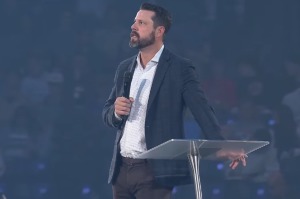
Most churchgoers say clergy talk about politics, social issues from the pulpit, survey finds
Abortion, Israel and homosexuality top list, researchers say

Even when the presidential election isn't on the ballot, American churches can serve as active forums for political and social commentary, according to a new survey released Wednesday comparing how Protestants and Catholics approach controversial issues in the pulpit.
Among U.S. adults who attend religious services at least once a month, two-thirds (66%) report that their clergy has discussed at least one political or social issue in the past few months, according to a Pew Research Center survey of 1,391 respondents conducted April 6 to 12. Abortion, Israel and homosexuality were listed as the most frequently mentioned topics.
Catholics and white Evangelicals are particularly likely to hear comments about abortion, while white Evangelicals are more likely to encounter frequent discussions of homosexuality at church.
Catholics report higher levels of discussion on immigration, with 15% hearing calls to welcome and support immigrants compared to just 3% hearing advocacy for stricter enforcement. Both Catholics and most Protestant groups hear more about protecting the environment (15%) than opposing regulations (3%). White Evangelicals, however, are less likely to hear environmental topics (about 13%) than other Christian groups (around 25%).
On sex and gender issues, 15% of regular attenders heard messages opposing transgender identity, while only 3% heard calls for acceptance. White non-Evangelicals proved to be the sole exception, researchers said.
"They are as likely to say their clergy urges acceptance of gay, lesbian and transgender people as to say they hear messages from the pulpit against homosexuality or against transgender identity," the report states.
Overall, the survey found regular attendees of both Protestant and Catholic groups were more likely to say their clergy spoke out against abortion, homosexuality and transgender identity than in support of abortion rights or LGBT-identified groups.
Discussions of U.S. military action in Iran in American churches were more muted and varied across the board. Roughly 8% said they heard opposition to the war from the pulpit, 4% heard support and 9% heard neutral talk about the conflict, according to Pew.
Support for Israel, by contrast, was clearer, especially among white Evangelicals and black Protestants.
The survey also probed perceptions of clergy partisanship and found nearly half (44%) of regular attenders say they are unsure whether their religious leaders lean Republican or Democrat. Another 27% described them as politically mixed.
Only 19% see their clergy as mostly Republican and 8% as mostly Democrat. White Evangelicals are most inclined to view their leaders as Republican (36%), while black Protestants are more likely to see a Democratic tilt (21%).
Data from the Pew survey comes from the American Trends Panel (ATP), Pew Research Center’s nationally representative panel of randomly selected U.S. adults. A total of 3,592 panelists responded out of 3,775 who were sampled, for a survey-level response rate of 95%.
The Pew findings are likely reflective of efforts by some Christian conservatives and churches who have pushed to remove the Johnson Amendment, arguing that the federal regulation unfairly restricts the First Amendment rights of houses of worship.
The National Religious Broadcasters, along with Intercessors for America, Sand Springs Church and First Baptist Church Waskom in Texas, filed a complaint in August 2024 seeking to stop the federal government from enforcing the Johnson Amendment, a 1954 law that prohibits some nonprofit entities from engaging in political activity and making political endorsements.
As the litigation continued, the IRS announced an agreement last July not to strip tax-exempt status when pastors and other religious leaders endorse political candidates to their congregations. In April, a federal judge rejected the agreement.