Poland's political, constitutional crisis explained: 5 events that led up to coup attempt

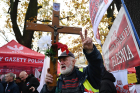
A protester flashes a Victory sign and holds a cross during a rally outside the headquarters of Poland's Constitutional Court in Warsaw on Oct. 31, 2026, after police blocked access to the building. Poland's President Karol Nawrocki called off a visit to Africa in mid-flight as riot police deployed around the country's constitutional court on Oct. 30 following the suspension of its chief justice in a battle between the centrist government and the nationalist right. Dozens of police guarded the entrance to the court as followers of the opposition right-wing Law and Justice party (PiS) protested the ousting of constitutional court president Bogdan Swieczkowski.
A protester flashes a Victory sign and holds a cross during a rally outside the headquarters of Poland's Constitutional Court in Warsaw on Oct. 31, 2026, after police blocked access to the building. Poland's President Karol Nawrocki called off a visit to Africa in mid-flight as riot police deployed around the country's constitutional court on Oct. 30 following the suspension of its chief justice in a battle between the centrist government and the nationalist right. Dozens of police guarded the entrance to the court as followers of the opposition right-wing Law and Justice party (PiS) protested the ousting of constitutional court president Bogdan Swieczkowski. | Sergei GAPON/AFP via Getty Images

Poland’s fight over its Constitutional Tribunal escalated into coup accusations Friday after a judge the president refused to swear in suspended the court’s chief and took control.

Anna Korwin-Piotrowska, the longest-serving judge on the Constitutional Tribunal, suspended Court President Bogdan Święczkowski and his deputy, Bartłomiej Sochański, and put herself in charge, The Telegraph reported. Her seniority claim rests on her judicial career, which began in 1995, not on service on the tribunal, which she joined this year.The tribunal accused Prime Minister Donald Tusk of staging a coup and posted on social media that "all persons participating in these actions are committing the crime of a coup d'état."

Justice Minister Waldemar Żurek, who is also attorney general, asked for the two judges to lose their legal protection so they could be charged with failing to do their jobs. He said they had stopped judges chosen by today's parliament from working. "This court has become private property; we must restore its proper functioning," he said.

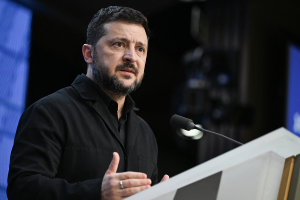
Tusk defended the move on X. "Restoring the rule of law is our duty," he wrote, adding that undoing years of rule by the opposition Law and Justice party, or PiS, was hard, at times painful, and required decisive action.

The tribunal decides if legislation is constitutional. The fight over who sits on it began in 2015 and escalated over the weekend. Here are five facts to know.  
Was this article helpful?

Become a CP Insider.
Help keep The Christian Post free for everyone.

The truth has a cost, and Insiders help carry it.
A dollar from an Insider comes with no strings attached. It keeps our reporters on the story, keeps our journalism open to everyone, and keeps every editorial decision in the newsroom, where it belongs.

Become a CP Insider and choose the amount you want to pay. You can change, pause or cancel anytime. As a thank-you, you’ll get:

  • The Insider Newsletter, a members-only monthly letter from our newsroom

  • Ad-free reading across christianpost.com


From as low as $8.25/month
Prefer to give once?

We’re sorry to hear that.

Hope you’ll give us another try and check out some other articles.
Return to homepage.

Most Popular

More Articles