Sing Conference: Wes Huff explains why 2,000 years of evidence supports the Bible


Apologist Wes Huff defended the historical reliability of the Bible at the Sing! Conference, explaining how centuries of manuscript evidence give Christians confidence that the Scriptures they read today accurately reflect the ancient texts.
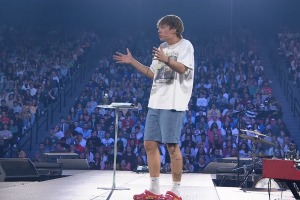
“The remarkable thing is not merely that the Bible survived; it is that we can examine the evidence for how it survived,” Huff told thousands gathered at the Gaylord Opryland Resort & Convention Center in Nashville, Tennessee, on Monday night.
“You can trust the text. You can trace its story, but the most important thing is that you actually read it.”
Huff, a Canadian theologian and apologist who has gained widespread attention through appearances on podcasts and debates, particularly following a 2025 appearance on Joe Rogan's podcast, delivered his message as part of the annual Sing! Conference led by Keith and Kristyn Getty.
This year's conference, themed “Symphony of Scripture,” marks 500 years since William Tyndale's English New Testament and focuses on the enduring influence of Scripture on worship and culture.
Huff structured his message around the acronym “TRUST”: text, reproduction, usage, survival and translation. His goal, he said, was to demonstrate how ancient biblical texts traveled “from the hands of their authors into ours.”
“How do we go from ancient papyri to modern-day print?” he asked. “What you hold in a modern English translation is taken directly from the original languages, the Greek and the Hebrew, and is rendered in a way that can be understood. And that's the legacy of someone like Tyndale.”
Pointing to ancient manuscripts such as Papyrus 66, which contains a nearly complete copy of the Gospel of John dating to around the late second or early third century, Huff said Christians today can compare their Bibles with texts read by believers living nearly 2,000 years ago.
Though handwritten biblical manuscripts contain textual variants, the sheer volume of surviving evidence allows scholars to identify and evaluate those differences, he said.
“Rather than undermining trust, these examples allow us to say we know these textual questions exist because we possess enough evidence to identify them,” Huff said. “Transmission was not perfect copying, but it was remarkably recoverable copying, and that distinction is important.”
Huff also rejected claims that the Bible could have been altered centuries after the biblical texts were written. By the early centuries of Christianity, he said, copies had spread across different regions and communities.
“The Bible survived not through one fragile chain of custody, but through a massive, distributed network of manuscripts and languages and quotations and translations and communities,” he said.
Translation, Huff stressed, has been part of the Judeo-Christian tradition for centuries, and differences between modern translations do not necessarily indicate corruption.
“Translation is interpretation, but that does not make translation arbitrary,” he said, adding that translations have changed wording only when necessary. “Your English Bible has been changed, but it's been changed for the sake of clarity, not for the sake of corruption."
Tyndale's determination to make Scripture accessible to ordinary people served as a recurring theme throughout Huff's message. Earlier in the day, John Piper shared Tyndale’s story with audiences: the Bible translator fled England in 1524 to continue his translation work and was later arrested and imprisoned. In 1536, he was executed after spending roughly 16 months in prison.
Huff recounted recently visiting Belgium and standing inside prison cells built from materials taken from the castle where Tyndale had been imprisoned.
“It's really stark to think about what people like Tyndale suffered for God's Word,” he said, adding that Tyndale's final words were reportedly a prayer: “Lord, open the eyes of the King of England.”
Less than two years later, an English Bible was ordered to be placed in every parish church in England.
“Tyndale's prayer was answered,” Huff said. “He died believing the Bible belonged in the hands of the ordinary people, the proverbial plowboys like you and I. Five centuries later, it does.”
“The Bible did not merely survive history; it survived in history, leaving evidence along the way,” the apologist concluded. “You can trust the text. You can trace its story, but the most important thing is that you actually read it.”
The three-day Sing! Conference will also feature Sinclair Ferguson, John Lennox, Malcolm Guite and Os Guinness, among others, along with the Gettys. Speakers throughout the conference are examining Scripture’s influence on the Church, worship, theology, apologetics and culture.
Before Huff's message, Keith Getty asked him about the reliability of Scripture in an increasingly post-Christian culture and amid the boom in artificial intelligence.
“The Word of God speaks clarity into that culture of confusion, and that's something that we can plant our feet firmly on,” Huff said. He also encouraged Christians not to feel they need to have an answer to every objection before engaging skeptics.
“I needed to be the Bible answer man. I needed to be the Christian encyclopedia,” he said of his former mindset. “And I'm finding more and more that just stepping up to the plate, you don't need to hit a home run. You just need to be willing to engage in the conversation.”
People today, Huff said, are searching for answers about “meaning and purpose and identity and justice,” creating opportunities for Christians to point them toward Scripture.
“I'm often surprised at just how receptive people truly are to things that have substance,” he said.
Asked how music fits into his work as a theologian and apologist, Huff pointed to biblical descriptions of Heaven filled with worship.
“Music can be that medium that connects the heart and the head in a way that other things can't,” he said. “It allows the intellect to really touch the heart.”
At Sing!, he added, Christians can “take in the beauty” while experiencing “the truthfulness and the richness of the Word of God.”
The Gettys also led attendees in worship during the gathering, including performances of their modern hymns “In Christ Alone” and “The Power of the Cross.”
Leah M. Klett is a reporter for The Christian Post. She can be reached at: leah.klett@christianpost.com