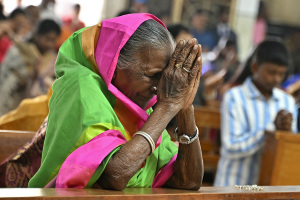
Rubio must press India on bill that could let state seize church property

When St. Francis Xavier arrived in Goa, India, on May 6, 1542, his historic missionary activity not only helped grow Christianity throughout India and the East, but also established a pattern of charitable activity that continues to be admired and forms the basis for so much Christian outreach to the needy. He tended to the needs of the poor and the sick, set up orphanages, established schools for those who were outcast, and more.
That charitable legacy, and similar efforts by other Christians, continues to provide a huge benefit to Indian society far beyond just Christians.
But that much-needed legacy of faith-based charity efforts, along with the very existence of many churches in India, is now facing the gravest of challenges in new legislation that could threaten nearly all of that work. With Secretary of State Marco Rubio now on a diplomatic trip to India, the U.S. has the opportunity to strongly urge India to make sure faith-based charities can continue to operate without fear.
This dire threat to Christian charities in India involves amendments to the Foreign Contribution Regulation Act, or FCRA. The FCRA is already burdensome, requiring any civil society organization to obtain a license to receive foreign funding. Over 20,000 FCRA licenses have been cancelled since 2010, often for unclear reasons, including the licenses of prominent Christian organizations such as the Evangelical Fellowship of India. Mother Teresa’s Missionaries of Charity had their licenses revoked until global outcry caused the government to reverse its decision. Given the immense poverty found in India, international financial support is vital for charities and religious organizations to survive.
But these proposed amendments would be even more devastating. A charity or religious organization can have its license revoked merely if the government thinks that its efforts negatively affect “social or religious harmony,” whatever that might mean. In a country that the U.S. Commission on International Religious Freedom regularly cites as a major violator of religious freedom for its laws that punish religious conversion away from Hinduism and where churches regularly face mob violence, it’s not difficult to see how Christian faith-based organizations will be viewed with suspicion.
Once a charity loses its FCRA license, the new amendments allow the Indian government to seize control of all of its assets and use them as the government sees fit. There is nearly no due process to stop an asset seizure from occurring. And while the amendments allegedly require that seized religious assets continue to be used for a religious purpose, nothing in the amendments prevents the government from using seized assets to benefit a different religion. Entire churches, hospitals, schools, and more could be taken with little recourse.
If you or any other American, or even the federal government, provided funds to support desperately-needed charitable work in India, that money could go into the hands of the Indian government just like that.
Recently approved FCRA regulations also expressly prohibit the use of foreign funds for “proselytizing.” The incredible work that St. Francis Xavier did hundreds of years ago can no longer be accomplished in India if any foreign funds are accepted. And if the name of Jesus is mentioned or a photo of Jesus is displayed in a Christian hospital, who’s to say that the government would not view that as “proselytization”?
The Indian government has claimed that the FCRA amendments are no different than what the U.S. has with its Foreign Agents Registration Act, or FARA. But that is simply false. The U.S. foreign agent rules involve the disclosure of foreign funds used to influence and lobby in American politics. That is a completely legitimate interest. What is illegitimate is creating a system where any charitable or religious activity supported by international funds creates suspicion and can lead to state-backed property seizure at the government’s whim. And that’s what the plans for India’s FCRA would do.
Secretary Rubio will be in India until the end of next week and must raise the concerns over these amendments while there. The U.S. might be the only global force that can put an end to this overreach. Rubio already signaled his concerns by visiting the Missionaries of Charity on his trip to India earlier this year, and Congressman Riley Moore’s X post against the FCRA caused so much consternation in India that the amendments were paused and sent to a reviewing committee.
But the FCRA amendments could return and be enacted at any time. Instead, they need to be stopped, and the U.S. and Secretary Rubio have the perfect opportunity to urge the Indian government to do so now.
St. Francis Xavier’s body currently lies in a silver casket at the Basilica of Bom Jesus in Goa. The Catholic Association of Goa has continued his great legacy by calling for the withdrawal of the FCRA Amendment Bill.
We in the U.S. should rally to our Christian brethren’s support in India to ensure that the great Christian legacy of mission and charity will be able to continue and thrive for hundreds of years to come.
Andrea Picciotti-Bayer is director of the Conscience Project and recipient of the Religious Freedom Institute’s 2025 Religious Freedom Impact Award.