Erwin Lutzer contrasts competing ‘gospels’ of Karl Marx, Dwight Moody in new book

One was the mind behind communism and much of modern socialist thought. The other was a famous traveling evangelist who founded schools and charities that still exist today.
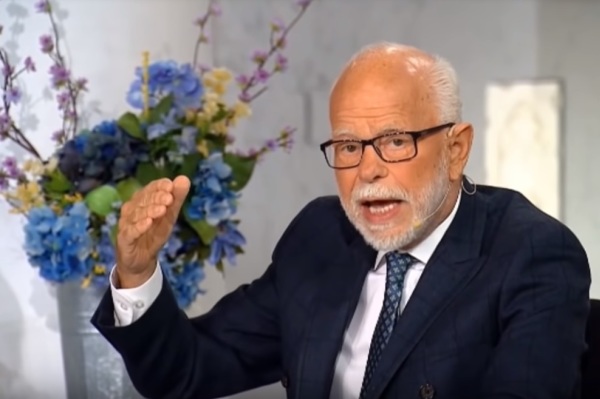
Erwin Lutzer, the 85-year-old author and former longtime senior pastor of The Moody Church in Chicago, Illinois, has co-authored a book contrasting the lives, legacies, and worldviews of 19th-century contemporaries Karl Marx and Dwight L. Moody.
Titled Marx and Moody: Two Contemporaries. Two Gospels. Two Tombstones. One Choice and co-authored with Gregg Quiggle, former D.L. Moody professor of historical theology at Moody Bible Institute, the book was released last month by Moody Publishers.
Lutzer wrote the sections on Marx, while Quiggle, who had previously written Bread and Bibles: D.L. Moody's Evangelism and Social Action(2024), wrote the sections on Moody.
In an interview with The Christian Post, Lutzer said the book's inspiration came when he visited Marx's final resting place in Highgate Cemetery in London, England.
As he prepared to film a lecture at Marx's grave site, Lutzer recounted that “it suddenly struck me that” Marx and Moody “were contemporaries,” with Marx's collaborator, Friedrich Engels, once visiting a Moody revival service in England.
“That began an interest, and I said, ‘What we need is a book that actually highlights these two individuals,’” Lutzer said. “Here are two towering figures in the 1800s.”

Fundamental differences
In his section on Marx, Lutzer was critical of the 19th-century writer's legacy, both regarding the fundamental assumptions of socialism and how it has been implemented worldwide.
Lutzer also acknowledged in his book that capitalism has had a history of corruption and poor implementation, but maintained that, fundamentally, capitalism was superior to socialism.
According to Lutzer, capitalism was “fundamentally” better because “it appeals to our initiative to want to better our position” and that “it has competition” that creates certain incentives.
“The competition makes prices lower,” he told CP. “Because everyone's going to want to produce goods, for as little as possible, so that theirs are the ones that get bought, and so forth.”
“Mamdani says in New York, ‘We're going to freeze the price of rent.’ Are people going to invest in rental property? I don't think so. Because now, they don't know whether or not they are going to have a profit or not, because that's not important.”
In June, New York City's Rent Guidelines Board voted to freeze rents on both one- and two-year leases for the city's roughly 1 million rent-stabilized apartments, fulfilling Mamdani's campaign promise.
In the book, Lutzer also documents his travels to the Soviet Union during the 1980s and learning how government-run businesses failed to produce useful products because they had no incentive to do so. One example was a shoe factory where the footwear being produced was actually not wearable, but since everyone there was guaranteed a job no matter what, they had no reason to make useful items.
“When competition folds out, people don't care whether or not they are making something that somebody is going to buy,” Lutzer told CP. “So that in itself creates huge problems.”
“So, the more the government begins to control prices, the more those prices get frozen and competition is lost, initiative is lost. … If you listen to the socialists, they are always talking about distributing money; they are really never talking about making money.”

'Marxist lite'
Another influence on Lutzer’s decision to write the book was the rise of Democratic Socialism in the U.S., with prominent examples such as Sen. Bernie Sanders, I-Vt., Rep. Alexandria Ocasio-Cortez, D-N.Y., and Mamdani elected to public office.
“While I was writing it, I discovered that suddenly, Democratic Socialism, which is really based on Marxism, is front and center in the news,” Lutzer told CP. “So, as I was writing, this began to happen as well, and it fell in line with what I was writing about.”
In the book and in his comments to CP, Lutzer labeled Democratic Socialism “Marxism lite,” explaining that the political movement “doesn't go as far as Marxism.”
Lutzer quoted a passage from the Communist Manifesto, in which Marx and Engels declared that “Communism abolishes eternal truths, it abolishes all religion, and all morality.” They answered it by arguing that the communist revolution "is the most radical rupture with traditional property relations; no wonder that its development involved the most radical rupture with traditional ideas."
“Well, the Democratic Socialists wouldn't say that,” Lutzer explained. “They're not saying you should stop believing in eternal truths such as God. Now, eventually there will be various things that will happen that will be the ongoing implications, but for now, it is primarily an economic theory.”
Lutzer said that the movement believes that “the greater hand the government can take into the means of production, the more equity there will be, the more prosperity there will be, the more goods we'll be able to have, and everyone is going to be able to function with a lot more equality.”
However, in both the book and in his remarks to CP, Lutzer felt it was “most important” to point out that “the reason that Democratic Socialism is so attractive is that people judge it by its promises, not its results.”
“If you list its promises, I mean, who doesn't want free healthcare, a guaranteed wage, free childcare, free bus fare?” he said. “The list can go as long as you want it to be. The only problem is you can't pay for it.”

A 19th-century Billy Graham
The book also details the life and ministry of Moody, an American evangelist who founded what later became known as The Moody Church and Moody Bible Institute.
Born into poverty and poorly educated, Moody grew up to become a shoe salesman and then, after a deep religious experience, became a preacher and prominent Chicago-based philanthropist.
In addition to preaching at revival meetings in North America and Europe, Moody also advocated for the abolition of slavery, founded schools for the less fortunate, and helped plant churches.
Lutzer compared Moody to the Rev. Billy Graham, and spoke about how amazed he was by “the extent to which Moody was willing to engage in the social needs of people.”
“There were times when he distributed food, he had founded orphanages, that is he would inspire people,” Lutzer told CP. “He would begin a ministry, put somebody else in charge of it, begin another and go on to something else.”
Moody was also friends with Charles H. Spurgeon, a famed 19th-century preacher at the Metropolitan Tabernacle Baptist Church whose ministry work resembled Moody’s.
“Because Moody was brought up in poverty, he was so sensitive to the needs of the poor. He did all that he could to help,” said Lutzer. “The only thing he was motivated by was the good news of the Gospel, which he knew people needed even more than their physical needs being met.”
“And so, he left the shoe business in which he was very successful and he began to give himself wholeheartedly to children and to evangelism.”
Legacy and modern understanding
Marx and Moody were two very different 19th-century figures. The final section of the Lutzer and Quiggle book contrasts their tombstones and what was written on them.
When asked by CP what he hopes people take away from Marx and Moody, Lutzer replied that he wanted readers “to understand their present situation” and to really focus on what their "legacy will be."
“I want them to be able to say, ‘OK, these are the roots of what we are seeing now in other countries which have adopted communism, of course and then in the United States where we see incrementally steps taken in that direction,’” he explained.
“I want them to be able to better understand their college kids who go to university and come back with a different view of truth, mainly that truth is not objective, it’s not outside of me, it’s what I think is truth, because truth ‘fluctuates.’”
Lutzer also wants those who read the section of the book centered on Moody “to be motivated as a Christian, to see the Christian aspect of what Christianity is all about.”
“Mainly, it is the Gospel, and it is not to the neglect of social needs,” said Lutzer. “In fact, Christians should be on the forefront of issues regarding poverty and the like, as Moody was in his day.”
“I want them to see what other people have been through, and what other people have had to endure and the price that has been paid for the Gospel in the past. I hope that comes through this book as well.”