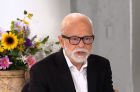
Christian activist defends placement of Elie Wiesel's memoir on 'inappropriate books' list promoted in Texas

A compilation of “inappropriate” Texas school books by a Christian advocacy group cited by Lt. Gov. Dan Patrick includes a book written by famed Holocaust survivor Elie Wiesel, with the group's representative warning about the book's depiction of brutality against children.
Patrick held a news conference on Aug. 19 to announce plans to back legislation to crack down on nearly 2,200 books that may be unsuitable for public school libraries.
Compiled by Recover America, the “Inappropriate Books in Schools” list includes several recognizable titles, including The Perks of Being a Wallflower by Stephen Chbosky, Slaughterhouse-Five by Kurt Vonnegut, and I Know Why the Caged Bird Sings by Maya Angelou.
The lengthy list also includes Night, the 1956 memoir based on Wiesel’s firsthand experience along with his father at Nazi concentration camps Auschwitz and Buchenwald near the end of World War II.
Recover America gave Night a score of 3 on its scale of 1 to 5, with 5 being the most “sexually explicit and pervasively vulgar."
While Wiesel’s book does not contain any sexually explicit content, Recover America’s Bonnie Wallace, who joined Patrick at the news conference, says that Night made the list due to its depiction of graphic violence involving infants.
“I included Night on my list because of the scene where the Nazi soldiers take the Jewish infants from their parents, toss them high into the air to use as target practice with their machine guns,” Wallace told The Christian Post on Thursday. “This imagery is stunning for the undeveloped brain of a child. I am not against this book and do encourage every adult in America to read this book but I prefer to err on the side of caution.”
Wallace noted that The Houston Chronicle, another outlet covering Recover America's “inappropriate books” list, also raised questions about why the graphic novel version of Lois Lowry’s award-winning dystopian novel The Giver was on the list.
“This book depicts images of murdering an infant boy by puncturing his forehead with a syringe filled with who knows what. Then the dead baby is placed in a box that says ‘waste,’” she said, adding that she believes the media outlet focused specifically on both Night and The Giver for a reason.
“If you take both the books that Houston Chronicle asked me about, it seems that they are very concerned about promoting or retaining books that show baby killings,” Wallace added. “Of course, in our society where abortion is applauded and promoted — and paid for — this does not surprise me.”

Night is one of several titles approved for students in ninth through 12th grade by the Texas Holocaust, Genocide, and Antisemitism Advisory Commission (THGAAC), an Advisory Commission to the Texas Historical Commission (THC). The book is lauded by organizations like the Baptist Joint Committee for Religious Liberty (BJC), which has, at the same time, publicly opposed the inclusion of the Bible in the Texas school curriculum.
In a June editorial for The Chronicle, Rabbi David Segal, policy counsel for the BJC, wrote about his concern that Texas “education leaders don’t seem very serious about biblical education” after the Texas State Board of Education (SBOE) in April approved more than a dozen Bible passages for a statewide list of required literary works.
Segal’s editorial took aim at the use of the King James Bible for classroom instruction, along with the state’s “religious preferentialism” for “contemporary translation choices,” which skewed Evangelical.
He also criticized the decision by the Texas Education Agency (TEA) to use the 1917 Jewish Publication Society translation for an eighth-grade assignment on Lamentations 3 because of its “themes of grief and vengeance and a worldview that sees the destruction of Jerusalem as God’s punishment for the Israelites’ sins.”
“Making matters worse, the state board and TEA grouped this text with Holocaust literature by Elie Wiesel and Primo Levi — which suggests that students should consider whether the Holocaust was God’s punishment for the Jews,” Segal wrote.
Such criticisms, said Wallace, miss the point about explicit materials in schools.
“The only way someone could make this statement is if they’ve never read the extreme sexually explicit books which pervade our schools,” she said.