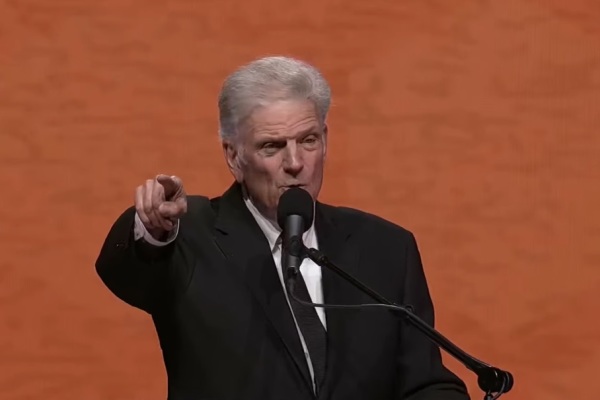


John Piper weighs in on 'doomscrolling,' urges Christians to stop consuming tragedy as entertainment

John Piper is urging Christians to rethink the way they consume tragic news, suggesting that every negative headline should serve not as fuel for endless "doomscrolling" but as a call to repentance.
In a recent episode of Ask Pastor John, the 80-year-old founder and teacher of Desiring God and chancellor of Bethlehem College and Seminary reflected on Luke 13:1-5, where Jesus responds to two tragedies by warning His listeners to repent rather than speculate about the sins of those who suffered. It's a passage, the pastor said, that speaks into how believers should process the constant stream of news.
"You deserve the same thing, so repent," Piper said, summarizing Christ's message. "That's what suffering should do to you: make you penitent."
Responding to a listener's question about whether God intends for Christians to regularly encounter news of tragedies, Piper pointed to Jesus' response after people informed Him that Roman governor Pontius Pilate had slaughtered Galilean worshipers. Rather than focusing on the victims' guilt, Jesus redirected the conversation toward the spiritual condition of everyone listening.
The Don't Waste Your Life author emphasized that many people assume those who experience horrific suffering must somehow deserve it more than others, yet Jesus rejected such an assumption.
"What he denies is that we can identify different degrees of badness in people from different degrees of suffering that they experience," Piper said. "And what he affirms is that you, the ones asking me this question — and I think that implies all of us — are just as liable to perishing as they are. Unless you repent, you're going to likewise perish."
Piper explained that Christ's warning about perishing refers ultimately to eternal judgment. The proper response to tragedy, he said, is not self-righteousness but gratitude that God has granted another day to repent.
Drawing from a sermon by late theologian R.C. Sproul titled "The Locus of Astonishment," Piper recalled being deeply impacted years ago while listening to the message as he vacuumed a room in his home. Sproul said that Christians often place their astonishment in the wrong place.
"What you ought to be amazed at is that you weren't among the number," Piper said, paraphrasing Sproul's point. "You weren't under the tower when it fell. That's the amazing thing that you and I are still breathing and have some time to repent so that we won't perish."
Piper cautioned against consuming tragic news merely for entertainment, shock value or emotional stimulation, also known as "doomscrolling."
"Looking at the news day-by-day on your phone, looking at the news just because it's interesting or shocking or titillating, is not good," he said. "That's not a good motivation."
Piper outlined six biblical reasons Christians should remain aware of suffering around the world. First, news of suffering should lead believers to repent of their own sins; second, it should remind them of God's sovereignty over suffering; third, hearing about persecution prepares Christians for their own suffering, which Jesus promised would come; fourth, learning about faithful believers enduring hardship can embolden other Christians to stand firm; fifth, awareness of global persecution reminds believers they are not suffering alone, and finally, knowing where suffering exists enables Christians to minister to those in need.
“We are not God,” he concluded, “and we cannot handle emotionally all the suffering of the world. We just can’t. It would crush us. If we saw everything happening right now that’s painful in the world, it would absolutely devastate us emotionally. We can’t handle it. We’re not God. We should want to know the suffering that moves us to action and makes us better Christians.”
Roughly 31% of American adults regularly doomscroll, with 51% of Gen Z and 46% of millennials caught in the same compulsive loop, according to a 2024 Morning Consult survey. Meanwhile, an April 2023 research review published in Applied Research in Quality of Life that analyzed three separate studies involving a total of about 1,200 adults found that doomscrolling is linked to worse mental well-being and life satisfaction.
Pastor Max Lucado recently weighed in on how Christians should engage with negative headlines in an interview with The Christian Post.
For believers overwhelmed by an endless stream of breaking news and social media outrage, Lucado noted that Elijah confronted evil when necessary, standing boldly before kings and false prophets. But he also withdrew into solitude, allowing God to restore him before returning to the work he had been called to do.
"There are times in which Elijah just confronted evil," Lucado said. "And then there are times in which he stepped away."
"I think there are a couple of big takeaways from the life of Elijah,” he added. “Number one, you know who you believe. You be sure of that. Again, the headline of Elijah's story is, 'The Lord God of Israel lives.' And then second, you trust in God to provide for what you need to fulfill your call."
Leah M. Klett is a reporter for The Christian Post. She can be reached at: leah.klett@christianpost.com