Trump's Religious Liberty Commission gathers for final hearing: 'No such thing as separation of church and state'

WASHINGTON — The seventh and final hearing of the White House Religious Liberty Commission gathered at the Museum of the Bible on Monday to discuss the past, present and future of religious liberty in the United States.
Chaired by Republican Texas Lt. Gov. Dan Patrick, the capstone hearing spanned five hours and featured panels that also touched on the history of religious freedom in the U.S. and the legal separation of church and state, which Patrick repeatedly dismissed during the event as a lie that is being politically weaponized.
"It is time to set the record straight: there is no such thing as 'separation of church and state' in the Constitution," Patrick said in a statement. "For too long, the anti-God Left has used this phrase to suppress people of religion in our country."
The lieutenant governor, who leads the commission with Vice Chair Dr. Ben Carson, noted that in all seven hearings of the commission since its establishment via executive order last May, "witness after witness testified that the so-called 'separation of church and state' was used to take their God-given religious liberty rights away."
'The biggest lie'
At one point during the hearing, Patrick called the idea of the separation of church and state, a phrase that emerged from an 1802 letter Thomas Jefferson wrote about religious liberty to the Danbury Baptists, as "the biggest lie that's been told in America since our founding."
Patrick made his remark in response to testimony from witness Helen M. Alvaré, a law professor at George Mason University's Antonin Scalia Law School who specializes in the religious freedom provisions of the First Amendment. She opened the hearing by framing religious liberty as an "objective good" for the country, emphasizing that government overreach poses a greater problem in American religious practice than any interfaith tensions.

"From time to time, this suffering is the result of malice; and recently, from governmental preoccupation with sexual expression," she said. "Quite often, however, it arises from a misunderstanding of that unfortunate, historically and culturally inaccurate, and constitutionally inapposite Jeffersonian phrase, 'separation of church and state.'"
Over the next few hours, the commission heard from two panels of other witnesses, some of whom testified how the supposed separation of church and state has been weaponized against people of faith. One witness included Sister Mary Elizabeth, SV, who detailed the legal battle the nonprofit Sisters of Life have faced from the state of New York, which she said "passed a law targeting our ministry to pregnant women."
"It allowed government officials to force pregnancy centers, but only those that do not perform abortion, to turn over internal documents, including sensitive information about the women we serve," she said.
Elizabeth also raised concerns regarding the case involving the Dominican Sisters of Hawthorne, New York, who run a Roman Catholic hospice for the poor. The group filed a lawsuit alleging the state violated their constitutional rights by requiring them to affirm the transgender identity of their patients.
'Dictatorship of relativism'
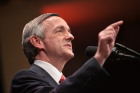
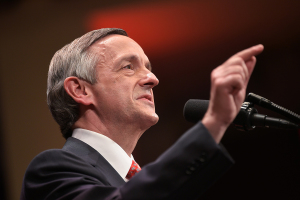
Commissioner Robert Barron, a Roman Catholic theologian who serves as bishop of the Diocese of Winona-Rochester in Minnesota, discerned that the major spiritual battle taking place in the U.S. is between traditional religious faith and the culture's prevailing moral relativism, which he suggested is ultimately the worship of self.

Barron said during a personal statement at the close of the hearing that "the principal enemy of religious liberty in our country is what I call the 'ideology of self-invention.'"
"This is the philosophical program that denies the objectivity of moral values and the stability of human nature, and which proposes consequently that individual choice alone is the determiner of purpose and meaning," he said.
"This dictatorship of relativism has taken hold in many of our institutions of government, education and health care, and its advocates correctly recognize that their most important intellectual opponents are precisely those who subscribe to traditional religion," he continued.
Barron warned that the self-worshiping, relativistic ideology has become culturally entrenched and that its proponents "want religion out of the pivotal institutions of our society."
He said their worldview lies at the heart of many of the problems the commission aimed to address, such as the dramatic rise of anti-religious violence in the U.S., attacks against parents seeking religious education, the surge of antisemitism from both sides of the political spectrum, and hostility toward healthcare providers who believe in objective biology or morality.
"Religious liberty is rightly called the first of our freedoms and the linchpin of our fundamental rights," he said, adding that he would urge the president to consider allowing the commission to continue beyond its charter, which will end on July 4.
"Threats to religious freedom, both at home and abroad, are not disappearing anytime soon, and I believe it's very much in the national interest to persevere in monitoring them," he added.
Barron also expressed concern at the unprecedented number of religiously unaffiliated Americans, warning that widespread ignorance of the Bible carries political implications in a system of government that emerged from the embers of Christian thought.
"That's dangerous for our democracy because people start forgetting. They don't hear the story of the Good Samaritan, they don't hear about the Ten Commandments, they don't hear the Beatitudes," he said. "That affects our democracy; it's not just a religious problem."
'Just stop-gap solutions'
Christian author and broadcaster Eric Metaxas, who spoke immediately after Barron, echoed the bishop's concern regarding ignorance of religion and history, warning that the commission's efforts are "just stop-gap solutions" if Americans fail to remember the Judeo-Christian heritage that made their religious liberty possible.
Metaxas stressed the historical fragility of religious freedom, noting that his mother came from East Germany, where liberty was lost to communism, and that his Greek father was cognizant of the centuries of religious persecution that followed the Islamic conquest of the Christian East.

"I think the reason we have this Religious Liberty Commission today is because we have, for many decades, failed to articulate what it means to be an American, what liberty is and is not, what religious liberty is and is not," he said.
"My principal recommendation to the commission and to everyone in America is that we must know our story. We must know what liberty is. We have to be able to articulate why it is that some faiths hate liberty and some faiths love liberty."
Metaxas, whose book about the American Revolution will be published in June, said he was struck while writing it by how deeply a biblical framework guided the founding of the United States. He noted the idea that human beings are endowed by a benevolent Creator with certain inalienable rights is "fundamentally a biblical idea."
"You don't have to like that, but it's a fact," he said. "So at the heart of America, at the heart of American liberty and religious liberty, is faith in the God of the Bible. And I think part of the reason we're in this mess is because that used to be assumed, but secularists in the last 100 years or so have undermined this."
"These things cannot be wiped away, but we've forgotten them. So I would say the more Christian faith we have in our culture, the more liberty we have," he added.
Metaxas urged his listeners to remember that religious liberty in the U.S. emerged from a Christian worldview, but that people of all beliefs benefit from its tolerance, even if their beliefs are in fundamental opposition to freedom.
After Metaxas spoke, Patrick said respecting different faiths was one of the things he and President Donald Trump spoke about when forming the commission, and that militant secularism serves as a common enemy to them all.
"And it's interesting, the secular movement attacks all of us. They don't just attack the Christians, they don't just attack the Jews, they don't just attack the Hindus. They go after everyone," he said.
'They're really afraid'
The commission is slated to wrap up its official duties next month when it delivers a report to the president on its findings, though Patrick echoed Barron's desire that it be extended.
"Yes, we would like to continue. Our charter expires in a couple of months, and I think if we all sent a letter and signed it to the president, we'd like to continue to monitor the outcome; and to continue to have hearings as needed, as stories break and news breaks, would be a great privilege," he said.
The commission has been fraught with controversy and infighting in recent months as religious questions increasingly take center stage in the national conversation.
In February, conservative Catholic activist and former Miss California USA Carrie Prejean Boller was removed from the commission following a tense exchange with Babylon Bee CEO Seth Dillon about Gaza, Zionism and the definition of antisemitism. Sameerah Munshi, a Muslim adviser to the commission, subsequently resigned in protest of Boller's removal and the war in Iran.
That same month, a lawsuit filed on behalf of The Interfaith Alliance, the Rev. Paul Brandeis Raushenbush, Muslims for Progressive Values, Sikh American Legal Defense and Education Fund and Hindus for Human Rights alleged the commission was unlawfully biased toward Christianity.
Patrick touched on the lawsuit during the hearing, suggesting its intention is to keep the commission from releasing their report, which contains months' worth of testimony from witnesses warning about the rising encroachments against religious liberty in the U.S.
"Really, all these groups should be titled, 'We're the group trying to stop good things from happening,' because someone doesn't want us to even turn in our report. That means they're really afraid," he said. "What are they afraid of?"
Jon Brown is a reporter for The Christian Post. Send news tips to jon.brown@christianpost.com