Trump's Religious Liberty Commission sued by interfaith coalition alleging bias toward Christianity

Quick Summary
- Interfaith coalition files lawsuit against Trump administration over Religious Liberty Commission.
- Plaintiffs allege commission is unlawfully biased toward Christianity.
- Defendants include President Trump and Attorney General Pam Bondi.

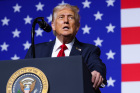
An interfaith coalition has filed a lawsuit against the Trump administration over its Religious Liberty Commission, an entity within the U.S. Department of Justice, it contends, is unlawfully biased toward Christianity.
The complaint was filed Monday in the U.S. District Court for the Southern District of New York on behalf of The Interfaith Alliance, the Rev. Paul Brandeis Raushenbush, Muslims for Progressive Values, Sikh American Legal Defense and Education Fund and Hindus for Human Rights.
Defendants named in the case include President Donald Trump, Attorney General Pam Bondi, the U.S. Department of Justice, the Religious Liberty Commission, and Mary Margaret Bush, the commission's designated federal officer.
“This case challenges the composition and secrecy of the Religious Liberty Commission,” the lawsuit reads. “While this body is ostensibly designed to defend ‘religious liberty for all Americans’ and celebrate ‘religious pluralism’ it actually represents only a single ‘Judeo-Christian’ viewpoint.”
“The Commission’s members have promoted the primacy of a Judeo-Christian world view in the public sphere, advocated for discrimination against minority groups under the guise of ‘religious liberty,’ and otherwise supported policies that threaten religious freedom for all those who do not conform to their particular worldview.”
“The Commission has also disregarded basic transparency requirements, including by failing to disclose transcripts, agendas, and other materials that would allow Plaintiffs and the public to follow and understand the Commission’s work,” the complaint alleged.
The groups maintain that the commission violates the Federal Advisory Committee Act, a 1972 law that curbs the Executive Branch’s reliance on advisory committees deemed “superfluous, secretive, and biased.”
In response to the lawsuit, a Justice Department spokesperson defended the commission, stating that it provides "opportunities for Americans from all walks of life to share their testimonies, concerns, and recommendations to better support Civil Rights and religious freedom in the United States."
“The Department of Justice’s mission is to uphold the rule of law and ensure fair and impartial justice for all Americans, which is an endeavor every American should support regardless of their political beliefs," the DOJ statement reads, according to Courthouse News Service.
The lawsuit states that the commission membership consists “of almost exclusively Christians with one Orthodox Jewish Rabbi,” all of whom believe “that America was founded as a “Judeo-Christian” nation and must be guided by Biblical principles.”
The plaintiffs are being represented by the progressive advocacy groups Americans United for Separation of Church and State and the Democracy Forward Foundation.
“The commission’s true purpose and operations can’t be squared with America’s constitutional promise of church-state separation,” said Rachel Laser, president and CEO of Americans United, in a statement released Monday.
“The commission’s public meetings — most of which have been held at the Museum of the Bible and have been dominated by a very specific brand of Christian faith, Christian prayers, and predominantly Christian speakers — are a vivid example of this favoritism.”
Trump launched the commission via an executive order in May, noting that it would have 14 members chosen by the president who “serve as educated representatives of various sectors of society, including the private sector, employers, educational institutions, religious communities, and States, to offer diverse perspectives on how the Federal Government can defend religious liberty for all Americans.”
“The Commission shall advise the White House Faith Office and the Domestic Policy Council on religious liberty policies of the United States,” the order continued.
“Specific activities of the Commission shall include, to the extent permitted by law, recommending steps to secure domestic religious liberty by executive or legislative actions as well as identifying opportunities for the White House Faith Office to partner with the Ambassador at Large for International Religious Freedom to further the cause of religious liberty around the world.”
The commission held its inaugural meeting last June at the Museum of the Bible in Washington, D.C., and was chaired by Texas Lt. Gov. Dan Patrick. Those involved in the meeting included Dr. Ben Carson, Bondi, Notre Dame law professor Gerald Bradleyand Mark Rienzi, a professor at The Catholic University of America.
During his remarks at last year’s meeting, Rienzi alleged that attacks on religious freedom have changed over the generations from internal Christian disputes to attacks on religion itself from secular groups.
“These days, frankly, I don't think it so much comes from religious people trying to use government to stamp out people with unpopular views,” he told the commission.
“I think it's now more often anti or irreligious folks who want to wield the government to stamp out views that are wrong. And I think the truth is, whether it's the religious people or the opponents of religion, it's wrong.”
On Monday, the commission held its fifth hearing to discuss antisemitism and religious liberty issues in the private sector.