Does evangelicalism really exist?

The controversial publication, withdrawal, and then republication by Christianity Today of an article suggesting Elisabeth Elliot was bisexual, amid a wave of layoffs and resignations that has stripped the Evangelical magazine of half of its staff, has raised numerous legitimate questions about its attitude to journalism, the wisdom of its editorial policy, and its future.
I don’t subscribe to it and have rarely read it, so I have no personal interest in the debacle, although the feckless strategy after the controversy broke would seem to confirm the best way to handle media storms: Never apologize, never explain, to paraphrase an adage favored by the late Duke of Edinburgh.
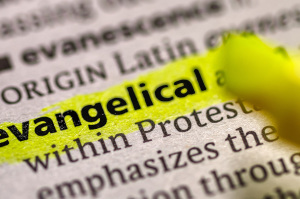
The chaos also raises an important, though rarely asked, question: Does evangelicalism really exist? Certainly it exists as a whipping boy for critics who treat the sins of any one Evangelical organization as the sins of all. It also gives others a platform: With no formal leadership, evangelicalism can be claimed by anyone with a social media account. But does it exist as anything more than a label?
Critics will no doubt point out that I have published books with Evangelical presses and co-host a podcast for the Alliance of Confessing Evangelicals. I am a fellow in the Ethics and Public Policy Center’s Evangelicals in Civic Life program, though the e-word was the one thing I queried when I agreed to join. If others want to see me as Evangelical and a participant in evangelicalism, they are free to do so. And yes, in my 25 years in the U.S., I have spoken at three national Evangelical conferences. But I have also spoken at Catholic, Lutheran, Anglican, Orthodox, and even secular equivalents, without being given those labels. So here is the rub: To describe me as Evangelical does not reflect my own self-understanding, nor does it explain me in any useful way.
If asked to describe myself, I typically do not call myself an evangelical. I am first a catholic, then a Protestant, and finally a confessional Presbyterian: a catholic because I affirm the truths of the Nicene Creed and the Chalcedonian Formula; a Protestant because I reject the pope’s claim to be the Vicar of Christ and the sacramental system of the Roman Church; a confessional Presbyterian because I affirm the Westminster Confession of Faith as a summary of the Bible’s teaching, and because I hold Presbyterianism to be the proper form of church government.
Applying Occam’s razor, I have no need of any further category, let alone one that possesses no agreed leadership structure, enjoys no theological consensus, and would place me in the company of others with whom I have little or nothing in common — indeed, many of whose views I would repudiate.
If evangelicalism lacks these things, then does the term fulfill any useful function? Many Christians are most committed to their local church. A subset has strong feelings of loyalty toward a denomination. It seems unlikely that commitment to something as nebulous as “evangelicalism” is the animating principle for many. Perhaps it is time to use the word only as an adjective, describing a cluster of shared traits, or “family resemblances,” such as those in David Bebbington’s quadrilateral: a high view of the Bible, a focus on the cross, an emphasis on conversion, and an active faith. A person or organization showing some or all of these might fairly be called “Evangelical.”
There is little chance of the e-word being demoted to an adjective. Too many have a vested interest in evangelicalism existing. They may not be able to define it, but they know it when they see it. Such a demotion would nonetheless be liberating.
I spend no time fretting about whether there are enough Evangelicals in positions of cultural or political power. I would like to see Christians in such positions; indeed, I am happy when there are Catholics on the Supreme Court. I would be happier still if they were Protestant (at least of a catholic variety), and would be ecstatic if they happened to be confessional Presbyterians. But in each case, the response would be the same: gratitude. By contrast, I feel no joy or gratitude at having a twice-divorced, thrice-married Evangelical prosperity preacher who regards an anti-Trinitarian as her spiritual mentor acting as faith adviser to the White House.
Evangelical she may be, but she is not part of any movement to which I belong.
To return to Christianity Today: The problem with organizations and institutions that claim the title “Evangelical” is that they always become arenas of conflict for the disparate groups that consider themselves normative for evangelicalism and thus entitled to speak for others who claim the name. Yes, denominations are subject to similar struggles. But denominations have formal structures and established procedures for handling such battles, while magazines, conferences, and even seminaries do not. Their battles are typically fought between opponents who each think they own the institution, with no mechanisms for resolving their disputes. Informal battles, often funneled through anarchic social media engagements, thus ensue.
Seen in this light, the recent chaos at Christianity Today is a practical example of the problems that arise when the word evangelicalism is reified, ceasing to be a loosely descriptive term and becoming something prescriptive. Everyone piles on, even those who can barely hide their glee behind their rhetoric of outrage.
I am not naive enough to think that the pundits will require the e-word to carry less freight in the future, let alone abandon it. Both its friends and its foes have too much invested in it for that to happen. To repeat: It is both a useful whipping boy to its foes and a ready-made (and conveniently unaccountable) platform for its friends. But abandoning the e-word would have its advantages, not least in helping to bring the catholic creeds and real churches back to the center of Christian self-understanding.
Originally published at First Things.
Carl R. Trueman is a professor of biblical and religious studies at Grove City College. He is an esteemed church historian and previously served as the William E. Simon Fellow in Religion and Public Life at Princeton University. Trueman has authored or edited more than a dozen books, including The Rise and Triumpth of the Modern Self, The Creedal Imperative, Luther on the Christian Life, and Histories and Fallacies.