

I grew up in Church. I didn't know why I needed Jesus

I grew up in church. But growing up in church and belonging to Christ are not the same thing.
I was there nearly every Sunday. I knew the language Christians used. I had heard Scripture and knew what Christians believed about Jesus. Christianity was part of the world in which I was raised, the way the church building itself was part of the town.
And I heard, more times than I could count, that I needed Jesus.
What I don't remember hearing was why.
The question underneath the invitation
The appeal usually began with the conclusion already reached: you need Jesus. As a young person sitting in church nearly every week, the question underneath that conclusion went unanswered. Why? What, exactly, was wrong that only Christ could fix? Without that foundation, the invitation could feel less like an explanation and more like a transaction waiting to be completed. Say the prayer. Walk the aisle. Make the decision. Check the box.
I resisted it. Not because I had carefully investigated Christianity and concluded it was false — I hadn't. I simply had not been shown why the problem Christianity claimed Christ came to solve was actually my problem.
Looking back, I don't doubt the sincerity of the people who wanted me to come to Christ. But sincerity cannot substitute for explanation. To a young man who did not understand the problem, repeated invitations to accept the solution eventually began to feel transactional — as though the objective were to secure a decision rather than help me understand why one was necessary.
That is a question worth asking pastors, myself included: are we sometimes so anxious for someone to make a decision for Christ that we fail to explain why Christ is necessary?
Scripture doesn't leave that question unanswered. Paul states the human condition without ambiguity: “As it is written, There is none righteous, no, not one” (Romans 3:10), and again, “for all have sinned, and come short of the glory of God” (Romans 3:23). That is not a problem invented by circumstances. It is not something that only becomes true when life falls apart. It is simply, objectively, the human condition — mine included, whether my life was working or not.
And Christ's answer to that condition is not contingent on how badly a person's life happens to be going: “For when we were yet without strength, in due time Christ died for the ungodly ... God commendeth his love toward us, in that, while we were yet sinners, Christ died for us” (Romans 5:6, 8).
I needed to hear that. What I heard instead, most often, was the conclusion without the argument. And a conclusion without an argument is easy for a young man to set aside.
When life seems to work without God
So, I set it aside. Not with a dramatic renunciation — I simply built a life elsewhere. I went to college, stopped attending church, came home, followed my father into the insurance business, eventually bought his agency, married, and settled into the ordinary architecture of adulthood: work, income, a household to run, a future to plan for.
I want to be honest about something apologists don't always say plainly: for a season, it seemed that I did not need God to explain anything. The business ran. The bills got paid. Decisions got made and mostly turned out fine. If someone had asked me what I believed about Jesus, I could have answered accurately — I hadn't forgotten what I'd been taught. I had simply stopped consulting it, because nothing in the life I'd built seemed to require it.
But here is the point that matters most, and the one I want to state carefully: my need for Christ did not begin later, when life became hard. I needed Him when I was healthy. I needed Him while the business grew. I needed Him on my wedding day. The problem Romans 3 describes doesn't wait for a crisis to become true. It was true of me the entire time I was managing quite well without ever thinking about it.
When life becomes something you cannot fix
By the time I reached my 40s, I had spent decades building a life outside the church. I had a career, responsibilities, relationships, and every reason to think I could continue managing life much as I always had.
Then life stopped being manageable. A serious medical crisis left me facing my own mortality and months of recovery. Not long afterward, my marriage ended, followed by financial difficulties serious enough that I had to start over. In a relatively short span of time, much of what had once seemed stable no longer was.
I'm not going to walk through the details. What matters is what all of it exposed. Piece by piece, the things I had unconsciously been relying on to hold my life together — competence, health, financial security, the ability to manage circumstances by working hard enough at them — stopped functioning as a substitute confidence. For a long time, they had been sufficient. Then they weren't.
None of this proved Christianity true. Nor did these hardships suddenly create my need for Christ. I had needed Him when I was healthy, when my career was going well, and when life seemed manageable. What changed was my confidence that I could continue living without ever confronting why.
Ecclesiastes 7:2 says something we would never put on a greeting card: “It is better to go to the house of mourning, than to go to the house of feasting: for that is the end of all men; and the living will lay it to his heart.” I had always known, abstractly, that life was fragile. Facing my own mortality, I was no longer dealing in the abstract.
“So teach us to number our days, that we may apply our hearts unto wisdom,” the Psalmist prays (Psalm 90:12). I had known my days were numbered the way everyone knows it. Now I was numbering them.
Hardship is not an apologetic argument
I want to state something plainly, because I think it matters coming from someone who now studies and teaches apologetics for a living. None of what I went through establishes that Jesus rose from the dead or that Scripture is God's Word. If I told you that suffering convinced me Christianity was true, I would be committing the very error apologetics exists to guard against — mistaking what I needed to be true for what is actually true.
What suffering did was something more precise. What the crisis destroyed was not my need for Christ, which Romans 3 says had been there all along, but my confidence that I could keep living adequately without ever confronting why.
A friend, speaking plainly
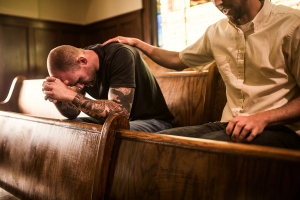
After the surgery, the end of my marriage, and the financial difficulties that followed, a personal friend who was also a retired pastor spoke to me with the love I needed.
He didn't ease into it. He told me plainly that he believed God had spared my life for a purpose and that it was time for me to accept Christ. His years of pastoral ministry were evident in the way he spoke — not mechanically, or as though following a script, but personally and directly, because he knew me. He brought me to the truth Paul states in Romans 10: “If thou shalt confess with thy mouth the Lord Jesus, and shalt believe in thine heart that God hath raised him from the dead, thou shalt be saved ... For whosoever shall call upon the name of the Lord shall be saved” (Romans 10:9, 13).
What stayed with me was not a technique. It was the love of a friend who had spent years caring for souls and who also knew what I had lived through. I needed someone willing to speak plainly about Christ, and I needed to hear it from someone I trusted. Our friendship continued for years, until his death.
I want to be precise about the difference between that conversation and everything I remembered from growing up in church. For years, people had told me that I needed Jesus, often as strangers or acquaintances extending a formula. This man did something different. He spoke to me as someone who knew me and knew what I had lived through. He did not treat me as another decision to be secured. He confronted me plainly with Christ and with the biblical call to believe.
I want to be equally careful about what that moment was not. Coming to the end of myself was not the same thing as coming to Christ. Emptiness is not conversion. What emptied me was circumstance. What filled me was the gospel, spoken plainly by a friend who cared enough to say the words out loud and point me to the text itself rather than to my own experience.
By the time I came to Christ in my 40s, I had spent decades knowing the vocabulary of Christianity without understanding why its central claim — that I needed Christ — applied to me.
Psalm 73 illustrates something related about the interpretation of experience, even though Asaph's situation differs from mine in an important way — he was already a man of covenant faith, wrestling with why the wicked seemed to prosper, not an unbeliever discovering the limits of self-sufficiency. But the pattern still instructs. Watching that apparent prosperity while he himself suffered, Asaph confesses, “when I thought to know this, it was too painful for me; until I went into the sanctuary of God; then understood I their end” (Psalm 73:16–17). His circumstances didn't change. His interpretation did. Suffering does not interpret itself. It must be interpreted in light of truth beyond the experience itself. For Asaph, that reorientation came in the sanctuary. For me, God used a friend who knew both the Scriptures and me well enough to speak plainly.
What about the ones who leave?
I don't tell this story often, and when I do, I try not to tell it in a way that promises other families the same outcome, because I cannot make that promise.
There are people in churches right now carrying quiet worry for a son, a daughter, a brother, a friend who grew up the way I did and walked away the way I did. I want to say something to them that is true without overreaching: don't assume that because someone left, everything they were ever taught left with them. I was not, in any meaningful sense, starting from zero when that friend finally spoke Christ plainly to me. Years of exposure to Scripture had not converted me, but they had given me a vocabulary whose significance I had never fully understood.
I'd also ask the church to consider something closer to home. If we tell people they need Jesus without explaining what they need Him for, we should at least ask whether they understand the invitation we are extending. I didn't. The invitation is not the whole of the Gospel. The Gospel includes the reason the invitation exists in the first place — creator, creature, sin, judgment, and a Christ who died for the ungodly while we were yet without strength. Leaving that part out doesn't make the Gospel easier to accept. It makes it easier to set aside.
So, to the Church, and to families waiting: don't panic, and don't assume. Don't chase the ones who've left with simplistic explanations, and don't assume their departure means they heard nothing worth remembering. But don't merely repeat the invitation to them either. Explain the problem. Keep proclaiming Christ faithfully — plainly, the way that friend did with me — to the people in front of you.
“To whom shall we go?”
In John 6, after a hard teaching, many of Jesus' disciples turn back and no longer walk with Him. He asks the Twelve a plain question: “‘Will ye also go away?’ Peter answers, ‘Lord, to whom shall we go? thou hast the words of eternal life’” (John 6:66–68).
I had gone plenty of other places before that friend sat with me — into work, into a marriage, into the ordinary business of building a self-sufficient life. None of those places were evil in themselves. Some of them were good. But none of them had ever answered the question I didn't know I was still carrying, and when the ground under all of them gave way at once, I finally let someone answer it.
Years later, I now stand on the other side of the pulpit.
And when I think about young people who may hear, as I once did, that they need Jesus without understanding why, I sometimes wonder how many will spend years setting the invitation aside — and whether someone will be ready, plainly and without apology, to tell them the reason.
When those questions finally come back, may we be ready not merely to invite them back to church, but to show them why they need Christ.
Stephen Phillip James is Senior Pastor of Seven Springs Baptist Church in Seven Springs, North Carolina, and a Ph.D. candidate in Applied Apologetics at Liberty University’s Rawlings School of Divinity. He earned his Master of Divinity in Christian Apologetics from Liberty University in 2023. His writing focuses on biblical apologetics, Christian worldview, hermeneutics, and the relationship between divine revelation and contemporary challenges to Christian faith. As both a pastor and student of apologetics, he seeks to make substantive biblical and theological arguments accessible to Christians engaging the questions and competing truth claims of contemporary culture.