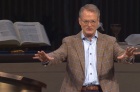
Jamie Winship and the Jericho debate: How do we discern innovative teaching?

Recently, I posted a short video clip from Jamie Winship, a popular evangelist whose ministry approach is viewed by some as innovative and by others as concerning.
I had not been familiar with his work prior to hearing his explanation of Joshua's conquest of Jericho through the concept of sonic dissonance. In describing what happens from a scientific understanding of sound resonance, he revealed how the walls could have collapsed due to Joshua's precision in following the Lord's instructions. As someone who appreciates thoughtful exploration and creative perspectives, I found the theory intriguing.
At the same time, as I listened to Winship's broader presentation, I noticed his tendency to avoid traditional biblical terminology in favor of language such as “intuition,” “consciousness,” and “imagination.” While those terms may resonate with some audiences, they understandably raise concerns for others.
After doing some additional research into his ministry, I quickly recognized why opinions about him vary so widely. The response to the video clip was revealing. Some immediately applauded the content and expressed appreciation for Winship’s perspective. Others raised significant concerns about his theology, ministry methods, and interpretation of Scripture. Some felt his explanation of Jericho diminished the supernatural nature of the biblical account, reducing it to a merely scientific phenomenon. Others questioned broader aspects of his teaching and evangelistic approach.
Are these concerns legitimate? I believe they deserve careful consideration.
The larger issue, however, is not Jamie Winship. He simply serves as a timely example of a challenge facing the Church today: How do we rightly discern both messages and messengers?
Scripture remains the ultimate authority by which all teaching must be tested. Regardless of how compelling, innovative, or effective a message may appear, believers are called to examine it through the lens of God’s Word. The Bereans provide a timeless model for us: “They received the word with all eagerness, examining the Scriptures daily to see if these things were” (Acts 17:11, ESV).
Yet discernment is not always as simple as identifying something as entirely true or entirely false.
Many of the issues confronting the Church today require thoughtful evaluation, careful questioning, and spiritual maturity. In an age increasingly concerned about deception, there is a temptation to replace discernment with reaction. Quick conclusions often take the place of patient examination.
This raises important questions. Does unconventional language automatically make someone unbiblical? Does a creative explanation necessarily invalidate a spiritual truth? Conversely, should visible ministry fruit excuse doctrinal concerns? Can genuine results coexist with theological weaknesses?
These are not always easy questions to answer.
From my limited exposure to Winship's ministry, I have been impressed by reports of Gospel impact among Muslims and unbelievers. That observation should not be interpreted as an endorsement of every aspect of his teaching. Rather, it acknowledges that fruit is one component of biblical evaluation. At the same time, fruit alone cannot serve as the final measure of truth. The question remains: Does the end justify the means? Where should those boundaries be drawn?
Perhaps one of the greatest challenges in discernment is recognizing that truth and error are not always found in separate camps. It is possible to hear truth from someone with whom we have significant disagreements. It is equally possible to hear error from individuals we deeply admire and trust.
For this reason, discernment requires more than doctrinal familiarity. It requires both a deep knowledge of Scripture and sensitivity to the Holy Spirit. The Word and the Spirit were never intended to operate independently of one another.
Those who are particularly drawn to the work of the Spirit often appreciate leaders who think creatively, challenge assumptions, and seek fresh ways to communicate biblical truth. Their passion is frequently directed toward reaching people rather than preserving traditions.
Yet history reminds us that passion and results alone are insufficient safeguards. The Church has witnessed gifted ministers bear remarkable fruit while simultaneously drifting into doctrinal error, moral compromise, or unhealthy expressions of authority. Good intentions and visible success can never substitute for sound doctrine and biblical accountability.
Therefore, the issue is not merely whether we approve of a particular messenger. The issue is how we evaluate what we hear.
The Church must resist two opposite errors. On one side is a rigid traditionalism that rejects anything unfamiliar simply because it challenges established assumptions. On the other side is an unchecked pragmatism that embraces almost anything if it appears effective. Neither extreme serves the cause of truth.
Jesus Himself modeled a better way. He challenged traditions, confronted religious assumptions, and often communicated truth in ways that surprised His listeners. Yet He never compromised the truth of God’s Word. He understood perfectly which boundaries could be challenged and which could never be crossed.
That distinction remains critical for believers today.
Christians will not agree on every secondary doctrine, ministry method, or public figure. Yet all believers are called to grow in their ability to distinguish truth from error, wisdom from folly, and the leading of the Spirit from the influence of the flesh.
The writer of Hebrews describes this maturity well: “But solid food is for the mature, for those who have their powers of discernment trained by constant practice to distinguish good from evil” (Hebrews 5:14, ESV).
The goal of discernment is not suspicion. Nor is it unquestioning acceptance. The goal is spiritual maturity — a maturity that faithfully honors both the Word of Truth and the Spirit of Truth.
Wanda has been in ministry for over 35 years as a worship leader, teacher, author, deliverance counselor, and speaker. The author of nine books, Wanda inspires believers to walk in the power of the Spirit and to mature through the Word and wisdom of God. Being a church planter and married to a pastor, she also speaks about godly leadership and equipping the saints for the work of ministry (Ephesians 4:11-13). Her vast online library of free resources, along with all her books and training videos, can be found on her website at WandaAlger.Me. She can be found on social media here:YouTube - UCZPqncM71LBx3cve_ngB6GQRumble - https://rumble.com/c/c-938547Facebook - https://www.facebook.com/wanda.algerX - https://x.com/WandaAlger5