Assyrian Christian community in Middle East 'doesn't have a chance of survival,' advocate warns
Quick Summary
- Karmella Borashan of the Assyrian International Council tells IRF Summit 'the West has repeatedly failed Assyrian Christians.'
- The Assyrian Christian community faces systematic persecution and a declining population.
- Experts urge Western nations and organizations to provide support for religious freedom.

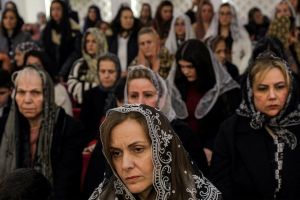
WASHINGTON — A religious freedom activist warns that the Assyrian Christian community in the Middle East "does not have a chance of survival” and offered sharp words of criticism at the sixth annual International Religious Freedom Summit, saying “the West has repeatedly failed Assyrian Christians."
During a Monday panel discussion titled “Voices from Underreported Religious Communities Caught Amid Conflict,” experts discussed the dire state of religious freedom in several countries and pleaded for help from the United States, Western countries and supranational organizations like the United Nations.
Karmella Borashan of the Assyrian International Council spoke about the plight of Assyrian Christians, which she noted dates back to the fall of Saddam Hussein in 2003 and the subsequent Syrian Civil War.
“Ever since, Assyrians faced systematic, subtle persecution from both the Jihadists and Kurdish forces, each using different tactics, and in Syria, lack of security and economic collapse specifically affects all Syrians, specifically Assyrian Christians as minorities," Borashan said. "Many villages that once were very thriving, they remain largely empty."
“In Iraq, they face violent attack by Islamist extremists,” she added. “Assyrian archeological sites more than 3000 years [old] are being vandalized.”
Borashan lamented the existence of “minority laws” that “forcibly convert children to Islam.” She insists that Assyrian Christians do “not have a chance of survival."
“Christianity is fading from the Middle East and [Christians] are placed in the mercy of the perpetrators,” Borashan detailed. “Once we had 1.5 million Christians, now we have only less than 300,000 left.”
The activist proclaimed that what the Middle East needs "is pluralism to bring the foundation of democracy.”
“Assyrian Christians were once a thriving and integral part of Iraq, Iran, Syria and Turkey, respected members of society with a Christian faith of more than 2000 years when Jesus came,” she said. “They have a history of more than 6,000 years. The West has repeatedly failed Assyrian Christians in the Middle East, abandoning them to the prominent powers that have persecuted and massacred them for generations.”
Sudan
Kamal Fahmi of the advocacy group Set My People Free detailed the challenges facing religious minorities in Sudan, a country gripped by a civil war since 2003. Sudan ranks as the fourth worst country for Christian persecution on Open Doors 2026 World Watch List, as converts from Islam often face rejection from their families, threats and violence.
“We have quite a number of victims who were executed or killed by their community because they left Islam," Fahmi said. "Most of the time, they have to leave the country to go somewhere else. And also when they leave the country, sadly enough, even within the U.N. system, they don’t get relocation easily.”
“Now with the insecurity, with the coup of the army, with the fighting of the two factions, ex-Muslims are very vulnerable,” he warned. “And sadly enough, this is not realized internationally, and nobody is working to really stop this. And they look at this as an impossible law which cannot be changed. And we have many people [who] are suffering.”
While a civilian government took shape in 2019, Fahmi lamented that a military coup “took away these freedoms again.” The war has resulted in “14 million displaced people,” he said, including 10 million who have been displaced within the country and 4 million who have been displaced outside the country.
“Even the U.N. is not able to help the displaced people in other countries and inside the country because they don’t have finance. So many people are facing hunger, but nobody’s talking about it,” he explained. “Today, Sudan is suffering, and the world is quiet. There is a lot about other countries, but Sudan is not mentioned, and even for relocation of people, it’s very difficult.”
Yemen
Keyvan Ghaderi of the Baha’is of Yemen described how he was arrested for his beliefs in Yemen in 2008 and released after four months.
“In prison, our faith was tested like … never before," he stated. "The majority of the inmates had never heard of the Baha’i faith.”
“At first, they called us infidels and treated us with suspicion and disdain. They refused to talk to us or share food with us. Over time, however, some of them insisted on eating and … talking to us to break down the prison rules,” he added. “Religious freedom and equal citizenship are not abstract ideas. They are foundations of [a] just and harmonious society. For Yemen, these principles are not only urgent but essential for healing and rebuilding a nation torn apart by conflict and division.”
Open Doors, which ranks Yemen as the third worst country for Christian persecution, states that dangers facing religious minorities in Yemen "continue to escalate amid an unrelenting tide of conflict, extremism and economic collapse." Yemen does not allow non-Islamic groups to register formally, and non-Muslim places of worship have not been authorized for years, the group notes.
"Discovery as a Christian can be deadly because in Yemen apostasy is legally punishable by death," Open Doors explains. "Believers can also suffer in other ways, including divorce and separation from their children. Yemen’s fragmented, weak rule of law only increases the dangers facing Christians."
Ryan Foley is a reporter for The Christian Post. He can be reached at: ryan.foley@christianpost.com