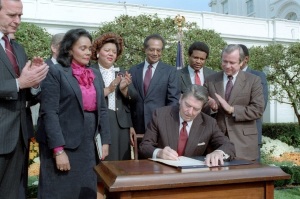
How Martin Luther King Jr. Day became a federal holiday

First proposed days after his assassination

Efforts to create a federal holiday in honor of the Rev. Martin Luther King, Jr. first began days after the prominent civil rights leader was assassinated on April 4, 1968, in Memphis, Tennessee.
Democrat Congressman John Conyers of Michigan first introduced a bill to make King's birthday, Jan. 15, a national holiday four days after the assassination, receiving the blessing of King’s widow, Coretta.
Congress was hesitant to take up the legislation, though Conyers proposed the bill every year and got the backing of the Congressional Black Caucus, among others.
In the meantime, ceremonies were held at the local level, especially in Atlanta, Georgia, reports the Smithsonian National Museum of African American History and Culture.
“King Day rituals began in Atlanta, with commemorative services held on January 15 at Ebenezer Baptist Church, which both Coretta Scott King and Ralph Abernathy attended. These events served as a template for federal holiday ceremonies,” explains the museum.
“The day began with Martin Luther King III placing a wreath at his father’s grave, followed by notable speakers. The congregation sang ‘We Shall Overcome,’ people drove cars with headlights on, and a Black state senator introduced a King holiday bill for Georgia. Many of these activities became rituals on subsequent commemorations in Atlanta.”