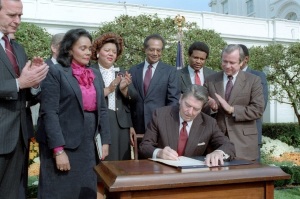
How Martin Luther King Jr. Day became a federal holiday

Resistance

Although Rep. John Conyers of Michigan introduced a bill to make Martin Luther King Jr.’s birthday a holiday every year starting in 1968, Congress hesitated to consider his proposals.
In 1979, the year King would have turned 50, the U.S. House of Representatives finally voted on the bill, which was backed by Democratic President Jimmy Carter. The legislation failed by five votes.
According to the Smithsonian National Museum of African American History and Culture, a major opponent of the 1979 bill was Republican Missouri Rep. Gene Taylor, who expressed concerns, including “the costs of an additional federal holiday” and “traditions that exclude private citizens from receiving recognition with public holidays named in their honor.”
Advocacy from King family members, singer Stevie Wonder and petitions signed by hundreds of thousands of people kept up support for the effort, with a bill designating the third Monday in January as Martin Luther King Jr. Day being introduced in 1983.
Another prominent opponent was Republican Sen. Jesse Helms of North Carolina, who accused King of being a communist and, in 1983, held a filibuster against the proposed legislation.
Nevertheless, the 1983 bill passed the House by a bipartisan vote of 330 to 90 and was personally introduced in the Senate by Republican leader Howard H. Baker Jr. of Tennessee, passing with another bipartisan vote of 78-22.