How Martin Luther King Jr. Day became a federal holiday

Signed into law in November 1983

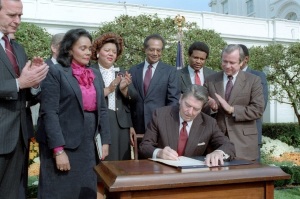
Republican President Ronald Reagan signed the bill making Martin Luther King, Jr. Day a federal holiday at a ceremony held at the Rose Garden of the White House, with members of the King family in attendance.
In his remarks, Reagan stated that “Dr. King had awakened something strong and true, a sense that true justice must be colorblind,” yet warned that “traces of bigotry still mar America.”
“So, each year on Martin Luther King Day, let us not only recall Dr. King, but rededicate ourselves to the Commandments he believed in and sought to live every day: Thou shall love thy God with all thy heart, and thou shall love thy neighbor as thyself,” he said.
“If all of us, young and old, Republicans and Democrats, do all we can to live up to those Commandments, then we will see the day when Dr. King's dream comes true, and in his words, ‘All of God's children will be able to sing with new meaning, `land where my fathers died, land of the pilgrim's pride, from every mountainside, let freedom ring.'”
Coretta Scott King also gave remarks, calling her late husband the “preeminent nonviolent commander” who helped make America “a more democratic nation, a more just nation, a more peaceful nation.”
“Martin Luther King, Jr., and his spirit live within all of us,” she added. “Thank God for the blessing of his life and his leadership and his commitment. What manner of man was this? May we make ourselves worthy to carry on his dream.”