Passion 2026: Cliffe Knechtle fields students’ toughest questions, from sexuality to God's existence


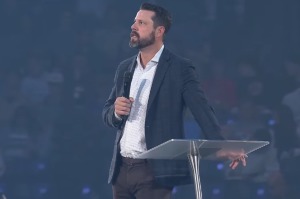
During a Passion 2026 session built around audience-submitted inquiries, Cliffe Knechtle, an American pastor and Christian apologist, addressed what organizers said were the most common questions young adults are asking today, including those about God’s existence, suffering, sexuality, morality and salvation.
“They submitted hundreds and hundreds and hundreds of questions,” Passion founder Louie Giglio told the crowd of thousands gathered at Globe Life Field in Arlington, Texas. “We collated them, took out the duplicates and raised them to the top.”
Knechtle, founder of the public apologetics ministry Give Me an Answer and senior pastor of Grace Community Church in New Canaan, Connecticut, framed the session as an honest conversation and repeatedly encouraged students to think critically and grapple seriously with doubt.
'What is the evidence that God exists?'
The 71-year-old pastor began by acknowledging his own struggles with doubt.
“I still doubt,” he said. “At times. I do not live my life as if God exists. I live at times in an embarrassing way, like a practical atheist. So at those times, I have to deal with my doubts.”
He said the first evidence that brings him back to belief is “order and design in the universe,” illustrating the point with an example from nature.
“There’s too much order and design in the beaver’s dam for it to happen by accident,” he said. “Too much order, too much design.”
Extending the analogy to the human body and the cosmos, Knechtle added, “To think that this amazingly complex universe as a result of chance plus fate plus time, is ludicrous.”
He cited Psalm 19, which states, in part, “The heavens declare the glory of God,” to point out that complexity itself points beyond randomness.
A second line of evidence, he said, is love.
“My experience of love shows me that there are intangible, nonmaterial, real things that exist, like love,” Knechtle said. “Love means far more to me than any scientific principle.”
He added that meaning and morality further support belief in God, arguing that humans cannot live as if life is meaningless or morality merely subjective.
'Does science contradict the Bible?'
Responding to questions about faith and science, Knechtle rejected the idea that the two are in conflict.
“If anybody tells you that science contradicts the Bible,” he said, “they don’t understand what science is, or they haven’t read the Bible.”
“Science is a study of process,” Knechtle said, emphasizing that the Bible does not attempt to function as a science textbook.
He cited historical scientists and referenced Galileo’s famous statement that “the Bible tells us how to go to heaven, not how the heavens go.”
“There’s no contradiction between hard science and faith,” he said.
'Is agnosticism the safest option?'
Some students suggested agnosticism as a neutral position, but Knechtle said it ultimately fails in real life.
“You can’t live your life that way,” he said.
He illustrated the point with a physical analogy, noting that everyday actions depend on conclusions drawn from evidence.
“You have to grapple with reality,” he said. “You’re gonna have to make a decision.”
He shifted the question toward moral consequence, asking how human life can be valued if existence is purely accidental.
“You can’t escape that,” he said. “You have to deal with it.”

'If God is sovereign, how do free will and predestination coexist?'
Knechtle agreed with C.S. Lewis that it is reasonable for God to give humans free will, even while remaining sovereign.
“It’s the self-limitation of God,” he said.
He argued that free will implies moral responsibility.
“God gave me a hand,” Knechtle said. “He gave me a hand to respect, to encourage, to help, not to smack somebody.”
He urged students not to fixate endlessly on theological debates, offering the reminder that the ultimate call on a Christian’s life is to share the Gospel.
“Please, please do not spend hours in your Bible studies debating predestination and free will,” he said. “Lead people to Christ.”
'What about people who have never heard of Jesus?'
Knechtle answered candidly.
“I do not know how God will judge those who’ve never heard about Christ,” he said.
What he said he does know is that “God is just,” adding, “God’s not going to rip anybody off.”
He emphasized that Scripture shows God responding to humility and faith, even before the time of Christ, and reiterated that salvation ultimately rests on Christ’s sacrifice.
“I do know that the only reason people go to Hell is because they choose to live their lives separate from God. And on the Day of Judgment, God will grant their request, and they'll spend eternity separate from Him. It is not God's will that any should perish,” he said.
“I knew He's going to be just and fair and compassionate and gracious. And I do know that all of us here, and all of … the people on every campus you are a student at, have more than ample opportunity to read the Gospels. We have more than ample opportunity to check out this Jesus and to ask, does the evidence point to Him being reliable, or does it not?”
'Is eternal suffering compatible with a loving God?'
Knechtle said he could not offer a detailed picture of Hell, but emphasized that Jesus spoke about it frequently.
“I don’t know exactly what Hell is going to be like,” he said. “Jesus spoke more about Hell than anybody else in the whole Bible. So I know Hell is real, but He did not give us a photograph.
He described Hell, at minimum, as separation from God and rejected the idea that judgment contradicts love.
“I think at the very least, Hell is separation from God,” he said. “[People say] ‘Oh, I'm looking forward to going to Hell because that's where my buddies are going to be, and we're going to have a kegger time out.’ But all of my abilities to enjoy life are gifts from God. In Hell, when I'm separated from God, I'm not going to have those abilities to have a party.”
“Heaven's gonna be a party, the best party ever, but it's not going to be ever degrading or dehumanizing each other,” he added.
'Why does God allow suffering?'
Knechtle shared a deeply personal story about the death of his 7-year-old niece in a car accident, recalling his brother’s response to the tragedy.
“Life hurts, suffering stinks, but God is good,” Knechtle quoted him saying. “Life is unfair. God is fair. Don’t get the two mixed up.”
He acknowledged that Christianity does not offer an easy or complete explanation for suffering, but pointed to the cross and resurrection as its central answer.
“Evil is real,” he said. “Forgiveness is real. … And three days after He died, Christ rose from the dead, which means there's a solution to suffering and death. … I do know that in Jesus Christ, we have God's solution to the very real problem of suffering and death. We have forgiveness and eternal life in Heaven.”
'How should Christians think about sexuality?'
Addressing questions shaped by modern views of sexual identity, Knechtle said sex is “a beautiful gift from God.”
“Please don’t let anybody tell you that sex is dirty,” he said. “It’s not.”
He affirmed a biblical framework for sexuality while acknowledging the pain caused by broken families and sin.
“You know it matters,” he said. “You know you’ve been scarred.”
“God created sex to be enjoyed within the context of a lifelong commitment between one man and one woman till death parts,” he said. “According to Jesus in the Bible, God gave us our sexuality for a purpose. For this reason, a man shall leave his father and mother, be united to his wife, and the two shall become one. That's the purpose. Am I going to live out the purpose for which God gave me this beautiful gift of sex, or am I going to totally pervert it in a zillion different ways?”
'Should Christians be involved in politics?'
Knechtle encouraged civic participation while rejecting partisan loyalty.
“America is a great country when America follows Jesus Christ,” he said. “America turns downright ugly and evil when America turns its back on Christ. I don't care if it's slavery, child sex trafficking trade, or the exportation of pornography [...] greed out of control, abuse of power. And that is why, my friends, I am not here to convince you to vote for a political party or for a particular politician, because I am convinced that the solution to America's problems is not the conservative agenda, it's not the liberal agenda. It's the Kingdom of God.”
“Please vote,” he said. “Vote your conscience.”
He further insisted that political systems alone cannot transform society.
“God has instituted government to maintain justice, to protect citizens,” he said. You and I, as Americans, have the right to vote. Please vote. Vote your conscience. Study the issues, study the Bible, have a biblical worldview of immigration, abortion, LGBTQ, money, helping the poor, respecting the rights of an individual justice, equality. … If you'll read the Bible and adopt a Christ-centered worldview on all those issues, you'll know how to vote.”
'How do believers discern God’s will?'
Knechtle described discerning God’s will as one of the hardest struggles in his own life.
“For me, I have difficulty discerning between my own fleshly desires and the Holy Spirit, because they both can sound like my conscience,” he said. “When is it God talking to me, and when is it Cliff talking to me?”
He urged students to ground themselves in Scripture, prayer, meditation and Christian community, emphasizing trust in God’s goodness.
“That's why we read the Bible, because that's God speaking truth into our lives, God revealing Himself to us. That's why we pray. […] Prayer is a struggle with God, where I'm seeking to learn to align my will with His will. My will aligned with His will. That's prayer. Prayer is intense. Prayer is focused. That's how you get to know God. Thirdly, you meditate. You learn to meditate. […] it’s giving God your undivided attention.”
“God is good,” he said. “You’re going to be all right.”
'What makes the Bible different from other holy books?'
Knechtle said faith in Scripture begins with examining the historical reliability of the Gospels.
“I can show you that the Gospels of Matthew, Mark, Luke and John are historically reliable,” he said.
“If you die and rise from the dead,” he added, “I promise to listen very carefully to everything you have to say.”
“Faith in Him is not blind. Faith in Him is a response to evidence. He's reliable. So based on that evidence of reliability, you take a step of faith and trust in Christ, and then you experience Christ's trustworthiness in your life,” he said.
“The reason I accept [the Gospels] as the Word of God is because the eyewitness community, those who knew Christ, insisted these guys are speaking the truth. It's right in line with what Jesus taught. And so that's why I accept the Bible as the Word of God.”
'What does it mean to become a Christian?'
In closing, Knechtle summarized Christianity as repentance and belief.
“To become a Christian means you repent and believe,” he said. “Repentance is not self-flagellation, whooping up on yourself, Oh, I'm a loser. It's not repentance. Repentance is taking responsibility for the wrong decisions I have made in my life and turning to Christ for forgiveness, and He promises to forgive. He promises to forgive when we ask him humbly for forgiveness and then to believe, to put our faith in Christ.”
He led attendees in a prayer and ended by singing the children’s hymn “Jesus Loves Me,” calling it “the most important truth in the universe.”
Passion 2026 continues through Jan. 3, drawing tens of thousands of young adults for worship, teaching and dialogue centered on the Christian faith.
Leah M. Klett is a reporter for The Christian Post. She can be reached at: leah.klett@christianpost.com