

David Henrie explores how faith, art have shaped cultures in 'Seeking Beauty' doc


David Henrie has spent most of his career in the secular entertainment industry, starring in popular projects ranging from Disney Channel’s “Wizards of Waverly Place” to feature films including “Reagan."
But when the actor, director and producer, a devout Catholic, was approached about hosting a new documentary series centered on beauty, faith and history, Henrie said he was thrilled at the opportunity to express his faith through his work.
“I’ve only done secular works, although I’m a man of faith, and I’ve been wrestling with this juxtaposition for a very long time,” the 36-year-old husband and father of three told The Christian Post. “But beauty happens to be something I’m really passionate about, because I think beauty, as I now understand it, is the language of the Divine.”
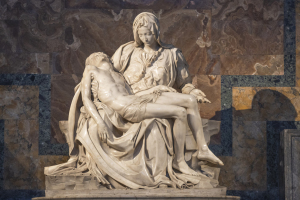
In “Seeking Beauty,” a six-episode adventure documentary series, Henrie travels through some of Europe’s most historically rich cities — including Vatican City, Rome, Florence, Milan, Subiaco and Venice — exploring how art, architecture, music and craftsmanship point beyond themselves to God.
Narrated by Henrie, “Seeking Beauty” brings together artists, historians and local experts to examine how beauty has historically shaped culture and faith and why it still matters today.
Henrie, who began acting when he was 9, said the concept challenged assumptions he had absorbed growing up in the United States: “Growing up in America, beauty wasn’t something really discussed or something that held a place of prominence,” he said. “In fact, it’s almost the opposite. It’s a cost that can be cut. It’s superfluous. It doesn’t help the utility of a thing, so therefore why do you need to do it?”
“I couldn’t be more wrong,” he added. “Beauty is the door that opens to truth and goodness. Beauty leads you to contemplation. Beauty is something that strikes you and gives you pause.”

As filming progressed, Henrie said his role shifted from observing beautiful places to personally encountering something deeper through them.
“It’s continually fascinating,” he said. “It’s this well that you realize is deeper and deeper and deeper, because it can invade every element of your life. Once you invite beauty in, it can start to take over.”
“Going to these museums and these beautiful places, you see people from all different walks of faith,” Henrie continued. “From women in hijabs to people who are homeless on the streets to people from all countries and belief systems, just in awe at what the ancient world had to offer, particularly ancient Christian minds and what they built. … Everything you see built, especially in Old Europe, is a reflection of that faith. What they believed Heaven looked like, what they believed their faith taught, that’s what you’re seeing.”
At its surface, “Seeking Beauty” functions as a travel series, Henrie said.
“I first and foremost wanted to make a travel show, something fun, something you can grab a glass of wine with your spouse, sit down and go, ‘Let’s plan our next trip,’ and get inspired," he added.
But beneath the surface, the series asks deeper questions about purpose and devotion. For example, Henrie pointed to the meticulous detail found in cathedral sculptures placed hundreds of feet above ground far beyond the view of everyday visitors.
“Why would someone put a statue on top of a cathedral that no one would ever see, with veins popping out of the arms?” he said. “Why do that? That seems silly.”
“But the answer is, some things are just for God,” Henrie continued. “They did that because some things are just for Him to see. That was their belief. And if you have no belief, that’s silly. But if you’re curious or you do have some belief, wow. What a powerful gesture.”
As a believer, Henrie said returning to these ancient places reshaped his understanding of time and spiritual depth. Centuries-old cathedrals and artworks continue to draw millions of visitors, he said, while modern projects quickly lose their appeal.
“What struck me is the ‘ever old, ever new’ mentality of ancient Christian minds,” he said. “We think if it’s newer, it’s better, that we’re smarter because of technology. But a lot of what we produce now goes out of style really quickly.”
“What was interesting to me is the juxtaposition,” Henrie added. “The modern things we’re producing now attract way less visitors, and these old things attract a ton. What was it about them that makes them so relevant today? These spaces were very intentionally designed. Nothing was wasted. It was all to bring people into the divine, to make a little Heaven on earth.”
That intentionality challenged modern ideas about art as self-expression.
“Modern art says art is just self-expression,” he said. “If you like it, who cares. If you don’t, who cares? That’s why you have all sorts of modern art that no one understands unless the artist explains it. Yes, the artist was expressing himself. But it was about a greater purpose and a greater calling. It was all ordered toward Christ.”
Spiritually, Henrie said the experience left a lasting mark; he was struck by the artists' faithfulness and dedication to using their talents for the glory of God.
“What hits me is how faithful the people were who built these places,” he said. “That inspires me as an artist and a creator. It inspires me to want to be as faithful as they were. If it wasn’t for that belief, these things wouldn’t be there. They wouldn’t be kept up. It’s that belief that made them so mesmerizing.”
The actor said he was struck by what has already proven lasting.
“There’s been this push for the past 50 or 60 years toward modern experiments, what’s new Christianity, what’s the new evangelization,” he said. “And after seeing all these things, I think the solution is very simple: orthodoxy.”
Quoting author G.K. Chesterton, Henrie added: “That’s the way forward. It’s not to go back, it’s to carry the flame forward. You don’t ditch the candle and invent a new light system. You pick it up, make sure it’s lit and carry it forward.”
Henrie recently completed filming the second season of “Seeking Beauty” in Spain, an experience he said challenged narratives he learned growing up, particularly about the Catholic Church’s role in history.
“There’s so much that was never taught,” Henrie said, citing Queen Isabella’s insistence on protecting the dignity of Indigenous peoples and sending priests with Columbus. “She’s nicknamed the mother of human rights, and I never learned that.”
While much of Henrie’s work remains secular, he said that what he learned through “Seeking Beauty” will impact his future projects, whether explicitly or implicitly. Rediscovering those stories, he emphasized, only reinforced the series’ central thesis: that beauty, truth and faith are God-given and inseparable from one another.
“These are interesting times,” he said. “We all need to find ways to band together again. For 1,500 years, we were one. We’ve got to figure out how to carry that forward.”
"Seeking Beauty" premieres Jan. 19 on EWTN+, with new episodes released weekly.
Leah M. Klett is a reporter for The Christian Post. She can be reached at: leah.klett@christianpost.com