Doug Wilson defends appearance at Pentagon, dismisses First Amendment concerns
Quick Summary
- Doug Wilson defends his appearance at a Pentagon worship service.
- Wilson dismisses First Amendment concerns regarding public prayer in government spaces.
- Critics argue the worship service violates the separation of church and state.

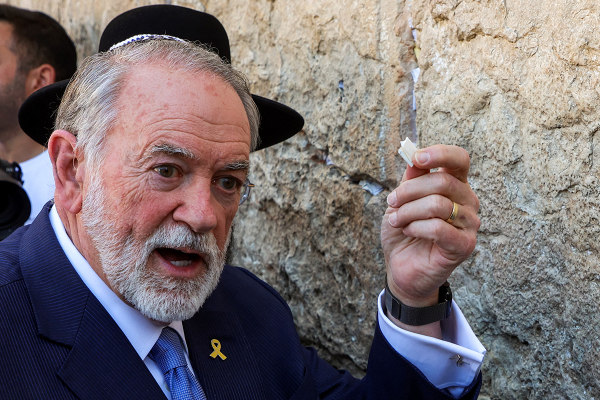
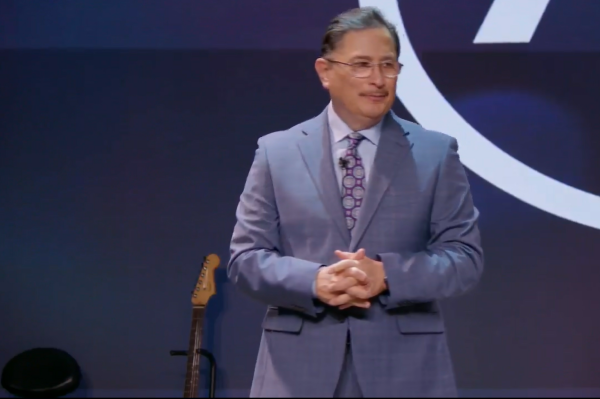
Pastor Douglas Wilson recently defended his appearance at a worship service at the Pentagon in Arlington, Virginia, last week, and pushed back against concerns that such public prayer in a government space is a violation of the U.S. Constitution.
Wilson, the senior pastor of Christ Church (CREC) in Moscow, Idaho, delivered a sermon last Tuesday at the request of Secretary of War Pete Hegseth, who has attended the church plant of Wilson's denomination, the Communion of Reformed Evangelical Churches (CREC), in Washington, D.C.
Under Hegseth's tenure, the Pentagon has provided a monthly voluntary Christian worship service for service members, prompting criticism from detractors who worry the services run afoul of the "separation of church and state," which is a phrase from a personal letter written by Thomas Jefferson.
In a Monday post on his blog, "Blog & Mablog," Wilson said CNN anchor and chief investigative correspondent Pamela Brown reached out to him after the service to ask if he had any response to criticisms that his "appearance is a broader part of the administration eroding the longstanding separation of church and state in the U.S."
Wilson posted his reply to Brown, claiming that the "actions taken by the Secretary of War in starting this prayer service are disrupting the 'longstanding separation of church and state,' but only if 'longstanding' is limited to recent decades."
"From the Founding of the republic it was not so. Worship services used to be held in the Capitol building, starting before the building was completed, and lasting up until the Civil War. Worshipers in that place included such worthies as Jefferson and Madison," he added.
Brown has recently been promoting her documentary "The Rise of Christian Nationalism," which she claimed was a "special project" that took her several months. The documentary, which is set to air March 8 on CNN, aims to examine what Brown defined as "an ideology rooted in the belief that our country was founded as a Christian nation, and that our laws and institutions should reflect Christian values."
The documentary is also poised to investigate the influence of the Association of Classical Christian Schools (ACCS), an organization that has ties to Wilson and whose president, David Goodwin, told Brown that he supports dismantling the U.S. Department of Education and would like to see the public school system go away.
Brown also interviewed Wilson last August, during which the pastor claimed "every society is theocratic," adding, "The only question is, whose 'theo'? In Saudi Arabia, theo is Allah. In a secular democracy, it would be 'demos,' the people. In a Christian republic, it'd be Christ. ... If I went to Saudi Arabia, I would fully expect to live under their god's rules." Wilson has raised eyebrows for supporting a repeal of the 19th Amendment enfranchising women and for supporting the criminalization of homosexuality.
In his Monday blog post, Wilson went on to explain that the Establishment Clause of the First Amendment to the U.S. Constitution was merely intended to prohibit a federally subsidized state church in a nation of many Christian denominations, but noted that some states retained their established churches at the time.
"To establish an official Church of the United States — a thing that Congress is forbidden to do — means that the following sorts of things would happen. A particular denomination of Christians would be selected, say, the Presbyterians, or the Anglicans, or the Congregationalists, and that church would be made the official denomination of the country," he wrote.
"The bald eagle is the national bird, the national flower is the rose, the national anthem is The Star Spangled Banner, and the national denomination would be whatever church you chose. As a consequence, that church would receive official benefits, such as having their ministers paid by the state. Your tithe would be bundled into your tax payments."
Wilson warned that while having established churches is biblically acceptable, such is likely "not the wisest course of action," given that even established churches are subject to apostasy.
"You have your established church, and you may laud its [Anglican] heroes like [Hugh] Latimer and [Nicholas] Ridley, and you are living out good deeds yourself, but time flies by, and you turn around to find some dame is the archbishop," he wrote.
"So while I don't think hard establishment is a good idea at the state level, an originalist view of the Constitution means that it is not an unconstitutional idea. I would be opposed to such a thing politically, not constitutionally. I would have no constitutional argument against it at all."
Wilson said he preferred what he described as "a soft establishment [of Christianity] at the national level," which he argued would be the natural consequence "when you simply acknowledge the existence of a broad Christian consensus."
Wilson has embraced the "Christian nationalist" label in the past while pushing back against its pejorative connotations. During an interview with Tucker Carlson in 2024, he placed the onus for restoring Christianity in the U.S. on preachers "who will stop being ashamed of the name of Jesus, and preach the Gospel as though it's supposed to spread out into the streets after the service."
Wilson recently fielded harsh criticism from former Secretary of State Hillary Clinton, who penned a lengthy article in The Atlantic last month likening President Donald Trump to Nero and Caligula while suggesting Wilson embodies a new "MAGA faith," which she claimed is morally rotten and finds its roots in misogyny.
Jon Brown is a reporter for The Christian Post. Send news tips to jon.brown@christianpost.com