'Historic moment': New law criminalizing revenge porn, AI deepfakes hailed as 'national victory'

Anti-sexual exploitation advocates commended President Donald Trump for signing a bipartisan bill championed by first lady Melania Trump that makes it a federal crime to post sexually explicit images of people online, whether real or AI-generated, without that person's consent.
The first lady joined the president on Monday for the signing of the TAKE IT DOWN Act in the White House Rose Garden. She thanked lawmakers on both sides of the political aisle for supporting the measure and called it a "national victory that will help parents and families protect children from online exploitation."
"Today, through the 'TAKE IT DOWN' Act, we affirm that the well-being of our children is central to the future of our families and America," the first lady said in a Monday statement. "I am proud to say that the values of BE BEST will be reflected in the law of the land."
In March, Melania Trump held a discussion on Capitol Hill that included anti-sexual exploitation advocates and members of Congress, as well as the survivors of nonconsensual intimate imagery and their families. On the day of the signing, President Trump praised his wife for her leadership and work to help secure the bill's passage.
"America is blessed to have such a dedicated and compassionate First Lady," the president stated.
The law, which received unanimous consent in the Senate and cleared the House last month in a 409-2 vote, prohibits the online publication of nonconsensual intimate images of individuals, both real and computer-generated.
Violators will be subject to mandatory restitution and criminal penalties, including prison and a fine. Additionally, threats to publish such content will also be subject to criminal penalties.
Covered platforms are also required to remove such content within 48 hours of receiving notice of its existence, and they must also establish a process for victims to report and request the removal of the sexually explicit material.
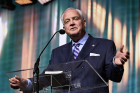
Marcel van der Watt, president of the National Center on Sexual Exploitation, a nonpartisan watchdog dedicated to raising awareness about the harms of all forms of sexual abuse, called the signing a "historic moment." The advocate believes that the law will create a "path" to removing image-based sexual abuse from digital platforms.
"Image-based sexual abuse is a horrific assault on a person, and that abuse becomes magnified on digital platforms. No one should have to endure sexual abuse through the creation of deepfake pornography or non-consensually-shared sexually explicit imagery," the NCOSE president said in a statement provided to The Christian Post.
"The TAKE IT DOWN Act will combat this abhorrent abuse, and we commend President Trump for signing this into law," he added.
Several tech policy experts and digital rights advocates have expressed concerns that the language of the legislation could result in the suppression of free speech and may be unconstitutional. Led by the Center for Democracy & Technology, critics of the bill sent a letter in February arguing that it "incentivizes the use of automated content detection and filtering techniques" that have limitations and could "lead to the inappropriate takedown and suppression of lawful speech."
However, groups like the National Religious Broadcasters have praised the law for tackling online abuse while upholding First Amendment rights.
In a Tuesday statement, Troy A. Miller, the president of the nonpartisan Christian organization, said that the NRB "applauds this important step in creating a safer digital environment."
"As a Christian organization, we believe it is a moral imperative and national priority to protect the dignity of every person, especially the most vulnerable, from exploitation online," Miller said. "The Take It Down Acts sends a clear message that innovation must not outpace ethical responsibility."
Melissa Henson, vice president of the Parents Television and Media Council, said in a statement to CP that she hopes the signing of the TAKE IT DOWN Act will help protect victims, including children.
"Of all the online threats to children, deepfake pornography might be the most insidious, because anyone — even children and teens who aren't online or don't use social media — can fall victim to it," Henson said.
The PTC vice president was invited to the signing at the White House, reflecting on the event as "bittersweet," but still "a powerful reminder of the difference people can make when they advocate for solutions that will protect future generations."
Samantha Kamman is a reporter for The Christian Post. She can be reached at: samantha.kamman@christianpost.com. Follow her on Twitter: @Samantha_Kamman