US sends troops to Nigeria to bring 'unique capabilities' amid ISIS fight
Quick Summary
- The U.S. has deployed a military team to Nigeria to assist in counter-terrorism operations against Islamic State-linked terrorists.
- This marks the first publicly acknowledged presence of American forces on the ground in Nigeria since U.S. airstrikes on Christmas Day.
- The deployment reflects expanding cooperation between the U.S. and Nigerian governments in response to escalating violence in the region.
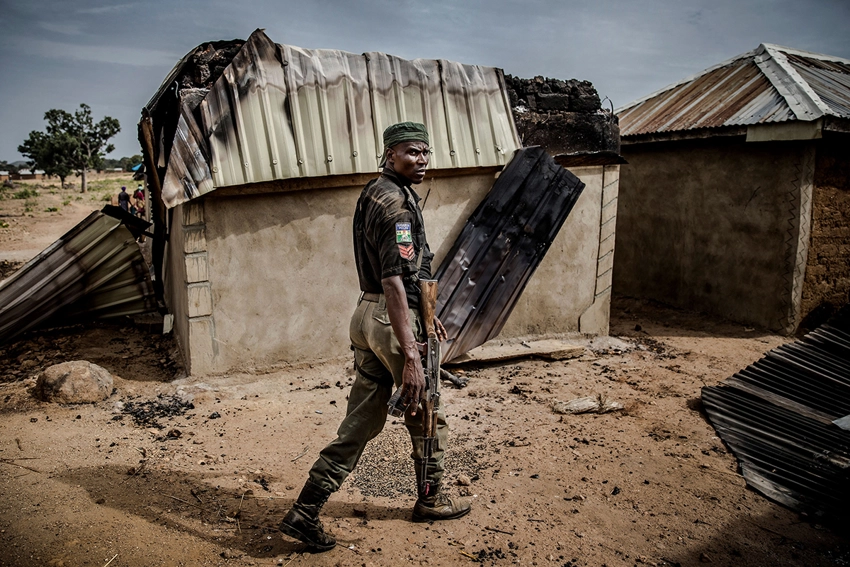
The U.S. has deployed a military team to Nigeria as part of a growing effort to assist in counterterrorism operations against Islamic State-linked terrorists. The move marks the first publicly acknowledged presence of American forces on the ground following U.S. airstrikes in Nigeria on Christmas Day.
A senior U.S. military commander told Reuters the deployment was carried out in agreement with the Nigerian government and reflects expanding cooperation between the two countries in response to escalating violence in the region.
General Dagvin R.M. Anderson, who heads U.S. Africa Command, was quoted as saying that the newly deployed American team brings “unique capabilities” to support Nigerian forces, adding that the deployment follows discussions between both governments about the need for increased collaboration.
Anderson did not provide specifics regarding the number of U.S. personnel sent or the details of their mission. The Pentagon has not issued a separate statement on the matter.
Nigerian Defense Minister Christopher Musa confirmed that U.S. personnel were active in the country, but declined to provide further details about the team’s scope or operations, according to the newswire.
A former American official with knowledge of the mission stated that the team is primarily involved in intelligence gathering and in supporting Nigerian military units in targeting extremist groups.
President Donald Trump had ordered airstrikes in December targeting Islamic State operatives in Nigeria and warned of further military action.
According to the U.S. Africa Command, the December airstrike was conducted in Sokoto state in coordination with Nigerian authorities. The operation resulted in the deaths of multiple Islamic State fighters.
In late October, President Trump accused Nigeria of failing to protect its Christian communities and described the escalating violence in the country as an “existential threat” to Christianity in the region.
The United States had already been conducting surveillance flights over Nigeria from neighboring Ghana since at least late November.
The Nigerian military has been locked in a long-running fight against insurgent groups in the country’s northwest and northeast, where militants from Boko Haram and Islamic State West Africa Province (ISWAP) have carried out repeated attacks on both civilians and security personnel.
The 17-year insurgency, which began in northeastern Nigeria and has spread to other parts of the country, has killed tens of thousands and displaced millions. The northwest has become a stronghold for various armed groups, including ISWAP and remnants of Boko Haram, which continue to mount lethal ambushes on security forces and villagers. A newly active group known as Lakurawa, believed to be linked to al-Qaeda’s West African affiliate JNIM, has emerged in the northwest. The group is reportedly armed with advanced weaponry and espouses a radical Islamist ideology.
In the country's Middle Belt, thousands have been killed amid years of communal violence that has displaced many predominantly Christian farming villages.
While advocates and religious leaders maintain there are religious elements and have accused the Nigerian government of failing to protect its citizens, the federal government has denied that it is neglecting Christian communities, maintaining that its operations are directed against extremist elements responsible for attacks on both Muslim and Christian populations.
The World Watch List 2026 report from Open Doors, released last month, notes that of the 4,849 Christians killed worldwide for their faith during the reporting period, 3,490 were Nigerian.
Last year, Trump announced that he would have the U.S. State Department designate Nigeria as a country of particular concern, a designation for countries deemed to tolerate or engage in religious freedom violations. The move was celebrated by the U.S. Commission on International Religious Freedom.
In November, Nigeria's President Bola Ahmed Tinubu ordered the recruitment of 20,000 new police officers, in addition to the 30,000 previously approved, and called for their rapid deployment to areas plagued by armed violence.