Huckabee responds after Jerusalem church leaders claim Christian Zionism is a 'damaging ideology'
Quick Summary
- U.S. Ambassador Mike Huckabee condemned the Jerusalem church leaders' Jan. 17 statement on 'Christian Zionism.'
- Church leaders claim Christian Zionism threatens unity among Christians in the Holy Land.
- Huckabee defends the views of free-church believers and emphasizes the importance of diverse Christian perspectives.
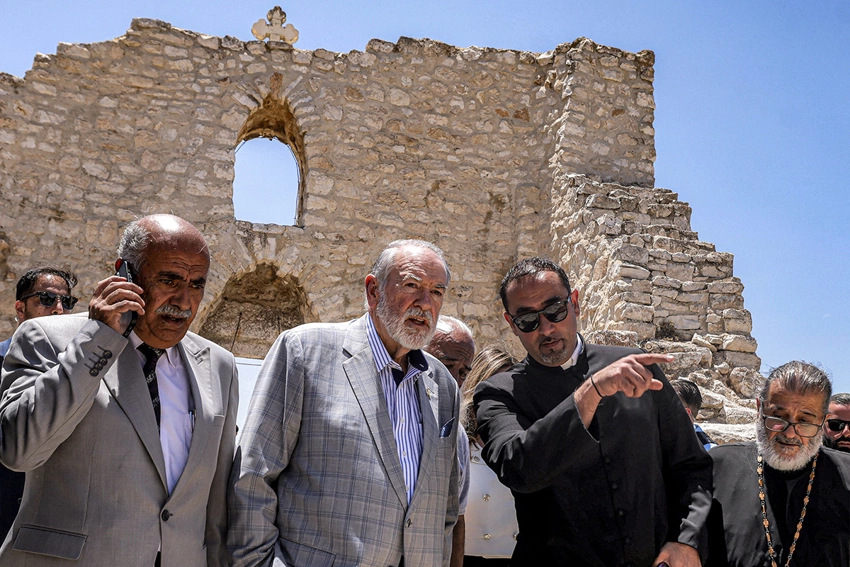
U.S. Ambassador to Israel Mike Huckabee has criticized Orthodox and Catholic church leaders in Jerusalem for disparaging "free-church believers" by claiming in a joint statement that Christian Zionism is a “damaging ideology” that threatens the unity of the Christian community in the Holy Land and undermines the authority of the historic apostolic churches.
In the Jan. 17 joint declaration, titled "A Statement from the Patriarchs and Heads of the Churches in Jerusalem on Unity and Representation of the Christian Communities in the Holy Land," the leaders claimed they have an exclusive role in representing local Christians, claiming that outside Christian groups that have a more pro-Israel stance don't speak for the Christian body.
"The Patriarchs and Heads of Churches in the Holy Land affirm before the faithful and before the world that the flock of Christ in this land is entrusted to the Apostolic Churches, which have borne their sacred ministry across centuries with steadfast devotion," the statement reads.
While the statement did not specifically identify any particular group or event, the patriarchate criticized recent activities by “local individuals” promoting ideologies including Christian Zionism, asserting that such efforts "mislead the public, sow confusion, and harm the unity of our flock." The leaders said these activities "have found favor among certain political actors in Israel and beyond who seek to push a political agenda which may harm the Christian presence in the Holy Land and the wider Middle East," but did not offer any additional details.
The Patriarchs and Heads of the Churches in Jerusalem comprise the Coptic and Greek Orthodox patriarchs; the Maronite, Melkite, Syrian, and Armenian Catholic patriarchs; the Armenian Apostolic patriarch; as well as Lutheran and Anglican leaders.
The statement comes more than a month after over 1,000 American pastors and Christian influencers toured Israel as part of The Friends of Zion Ambassadors Summit and pledged to support the Jewish people. The event was organized in partnership with the Israeli Ministry of Foreign Affairs. During the event, the delegation laid flowers on the graves of soldiers who died during the Israel-Hamas war and witnessed the impact of the terror group’s Oct. 7 massacre.
Citing the book of Romans, the Patriarchs and Heads of the Churches in Jerusalem statement argued that anyone claiming "authority outside the communion of the Church is to wound the unity of the faithful and burden the pastoral mission entrusted to the historic churches in the very land where our Lord lived, taught, suffered, and rose from the dead."
The church heads expressed concern over external engagement outside the Christian community, noting that individuals advancing these views "have been welcomed at official levels both locally and internationally." Without providing any details, the statement described such actions as "interference in the internal life of the churches [which] disregard the pastoral responsibility vested in the Patriarchs and Heads of Churches in Jerusalem."
The patriarchs reiterated “that they alone represent the Churches and their flock in matters pertaining to Christian religious, communal, and pastoral life in the Holy Land."
Huckabee, a conservative Evangelical and former Southern Baptist minister who served as governor of Arkansas, criticized the church leaders in a social media post Tuesday for the "exclusive" tone in the statement and for using a "pejorative" to "disparage free-church believers."
"I love my brothers and sisters in Christ from traditional, liturgical churches and respect their views, but I do not feel any sect of the Christian faith should claim exclusivity in speaking for Christians worldwide or assume there is only one viewpoint regarding faith in the Holy Land," Huckabee wrote. "Personally I’m part of a global and growing evangelical tradition that believes the authority of Scripture and the faithfulness of God in keeping His covenants. That includes His covenant with Abraham and the Jewish people. My Christian faith is built on the foundation of Judaism and without it, Christianity would not exist."
"The thought that God is even capable of breaking a covenant is anathema to those of us who embrace Holy Scripture as the authority of the church. If God can or would break His covenant with the Jews, then what hope would Christians have that He would keep His covenant with us?" he added. "Labels such as 'Christian Zionism' are too often used in a pejorative manner to disparage free-church believers, of which there are millions across the planet. Christians are followers of Christ and a Zionist simply accepts that the Jewish people have a right to live in their ancient, indigenous, and Biblical homeland."
Huckabee said he couldn't understand why "every one who takes on the moniker 'Christian' would not also be a Zionist."
"It’s not a commitment to a particular government or government policy, but to the Biblical revelation as given to Abraham, Isaac, and Jacob. In my faith, there is certainly room for those who 'butter their bread' differently than me, and I would hope that there would be room in the hearts of other church bodies for me. We need to unite in those truths that should be agreed upon, such as the sanctity of life, the sacred act of marriage, the autonomy of the individual, the desire to lift up every human and alleviate human suffering, and the belief that grace is God’s gift to us all."
Simone Rizkhallah, who served as director of Philos Catholic, an initiative of the Philos Project dedicated to exploring the Catholic Church’s relationship with the Hebraic and Near Eastern foundations of the Christian faith, believes distinguishing between orthodox Christian faith and Christian Zionism is not merely “a matter of polemics, but of theological clarity and fidelity to the Church’s own teaching.”
While she stated that the “Catholic faith is not Christian Zionism,” and called such an approach “foreign to Catholic theology,” Rizkhallah said it’s essential to see the bigger theological picture.
“Rejecting Christian Zionism does not require rejecting Zionism altogether, nor does it excuse Catholic ambivalence toward the Jewish people’s return to their ancestral homeland,” Rizkhallah told The Christian Post. “Catholics possess their own intellectual and moral inheritance here, one that neither baptizes modern geopolitics nor treats Jewish attachment to the land as theologically meaningless.”
Christian Zionism, which emerged largely from a dispensationalist End Times interpretation, maintains that the founding of modern-day Israel in 1948 was a fulfillment of prophecy and a prerequisite for the Second Coming of Jesus Christ, which often translates into political support for Israel.
Critics of Christian Zionism, a theological and political movement prominent especially among U.S. Evangelicals, argue that it prioritizes support for Israeli policies — including settlement expansion — as a fulfillment of biblical prophecy, often at the expense of Palestinian Christians' rights and presence. The movement's adherents frequently view Jewish sovereignty over historic Palestinian territories as essential to End Times prophecy.
In recent months, Christian Zionism has become a controversial topic for Evangelicals and other high-profile figures who identify as Christian, including former Fox News commentator Tucker Carlson, who publicly apologized in November after he stated that he dislikes Christian Zionists.