King Charles III, incoming archbishop of Canterbury push 'diversity,' immigration on Christmas

King Charles III and the incoming archbishop of Canterbury, the Most Rev. Sarah Mullally, delivered Christmas messages that emphasized diversity and immigration as the U.K. faces simmering tensions over the issue.
The king opened his address by highlighting his historic meeting with Pope Leo XIV in October, during which he participated in an ecumenical worship service in the Sistine Chapel that featured both Anglican and Roman Catholic liturgy.
"A few weeks ago, the queen and I were delighted to make a state visit to the Vatican, where we prayed with Pope Leo in a historic moment of spiritual unity," he said.
The event marked the first time a reigning British monarch has attended such a service since the English Reformation nearly 500 years ago.
While some claimed that the service was a symbolic healing of the rift from the Reformation, which manifested politically in England when King Henry VIII broke with Rome in 1534, others found it to be an affront to historic English Protestantism and indicative of the king's syncretism that also seeks to appease Islam.
During his Christmas address, King Charles III went on to emphasize the importance of the Vatican's 2025 Jubilee Year theme, "Pilgrims of Hope."
"Pilgrimage is a word less used today, but it has particular significance for our modern world, and especially at Christmas. It is about journeying forward into the future while also journeying back to remember the past and learn from its lessons," he said, going on to praise the sacrifices of those who fought for Great Britain in the World Wars, before appearing to pivot back to present-day issues.
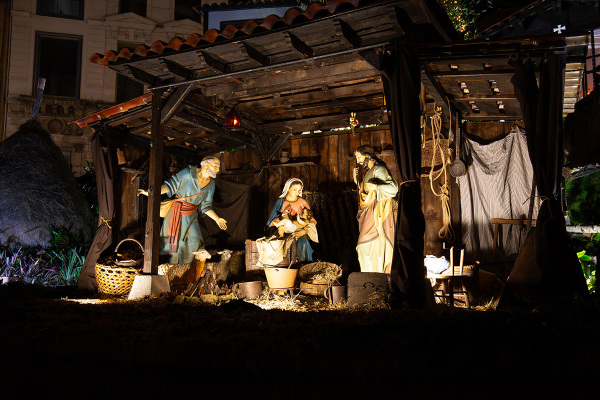
"Journeying is a constant theme of the Christmas story. The Holy Family made a journey to Bethlehem and arrived homeless, without proper shelter. The Wise Men made a pilgrimage from the East to worship at the cradle of Christ; and the shepherds journeyed from field to town in search of Jesus, the Savior of the World. In each case, they journeyed with others, and relied on the companionship and kindness of others," he said.
“Journeying is a constant theme of the Christmas Story. The Holy Family made a journey to Bethlehem and arrived homeless without proper shelter. The Wise Men made a pilgrimage from the East to worship at the cradle of Christ; and the Shepherds journeyed from field to town in… pic.twitter.com/j0wbYdPWa9
— The Royal Family (@RoyalFamily) December 25, 2025
"Through physical and mental challenge, they found an inner strength. To this day, in times of uncertainty, these ways of living are treasured by all the great faiths and provide us with deep wells of hope; of resilience in the face of adversity, peace through forgiveness, simply getting to know our neighbors, and by showing respect to one another, creating new friendships."
"Indeed, as our world seems to spin ever faster, our journey may pause to quieten our minds — in T.S. Eliot's words — 'at the still point of the turning world,' and allow ourselves to renew."
"In this, with the great diversity of our communities, we can find the strength to ensure that right triumphs over wrong. It seems to me that we need to cherish the values of compassion and reconciliation, the way our Lord lived and died," he said.
The king later reiterated his admiration for different faiths, suggesting they have much in common.
"As I meet people of different faiths, I find it enormously encouraging to hear how much we have in common, a shared longing for peace and a deep respect for all life. If we could find time in our journey through life to think on these virtues, we could all make the future more hopeful," he said.
The king's Christmas address was met with mixed reactions on social media, with some praising him for mentioning Jesus Christ and calling for unity, while others criticized him for promoting "diversity" in the wake of mass migration that is putting a strain in the economy and public services, and has sparked protests that have roiled the U.K. this year, including the "Unite the Kingdom" march in London that drew more than 100,000 people in September.
"King Charles used his Christmas message to gush about Islam, Judaism, Hinduism, and the 'diversity of our communities,'" said Connor Tomlinson, a U.K.-based Gen Z political commentator. "He appealed to the Boomer mythology about the Second World War and 'our values' to overcome 'division at home.' Give it a rest, it's Christmas. Today is about Christ, our traditions, and not foreign religions or liberal platitudes. Take our side, for a change."
U.K.-based journalist Joseph Robertson criticized the king for "leaning into the 'diversity is our strength' bollocks — almost verbatim."
"Delivered without a flicker of self-awareness. Our Christmas message to the monarch is very simple — you stand for nothing. Least of all your subjects," he added.
Mullally, who currently serves as bishop of London and will be formally installed as the first female archbishop of Canterbury in January, delivered a Christmas sermon at the historic St. Paul's Cathedral that also drew on the Nativity story to warn that the debate over immigration in the U.K. has grown too divisive, according to The Guardian.
"Joy is born exactly where despair expects to triumph. As joy breaks through in our lives it gives us the opportunity to become people who make room," she said. "Room in our homes. Room in our churches. Room in our public conversations and in the attitudes we hold."
Mullally went on to imply that those concerned over the scale of immigration to the U.K. are exhibiting the same attitude that shut the Holy Family out of the guest rooms in Bethlehem.

"The joy asks us to allow our lives to be interrupted by the needs of others, just as the people of Bethlehem were interrupted," she said.
"This insight matters because our own society carries uncertainties that can wear us down. Many feel the weight of economic pressure. Some feel pushed to the margins."
"Our national conversations about immigration continue to divide us, when our common humanity should unite us," she added.
After the announcement in October that Mullally would serve as the Church of England's next ceremonial head, the GAFCON movement of orthodox Anglicans announced its intention to renounce the spiritual leadership of the archbishop of Canterbury and launch the Global Anglican Communion founded on the Bible alone.
The impending installation of Mullally, who has openly affirmed abortion and homosexuality, prompted some in the global Anglican Communion to claim that the Church of England has been given over to apostasy.
Jon Brown is a reporter for The Christian Post. Send news tips to jon.brown@christianpost.com