

The Christian Post's top 10 news stories of 2025 (part 2)

2. Trump pressures Nigeria to protect Christians
After about a decade of advocates and watchdog groups sounding the alarm on violence impacting Christian communities in Nigeria, which has led to thousands killed and millions displaced, the U.S. government is now pressuring the Nigerian government to take action to protect its citizens, following years of what critics say have been inadequate responses.
President Donald Trump made headlines in late October when he posted on Truth Social that Christians are facing an "existential" threat in Nigeria and vowed to have the U.S. State Department place the country on its list of Countries of Particular Concerns, a designation that was removed during the first year of the Biden administration in 2021 despite the objections of the U.S. Commission on International Religious Freedom.
"Radical Islamists are responsible for this mass slaughter," Trump wrote.
"When Christians, or any such group, is slaughtered like is happening in Nigeria (3,100 versus 4,476 Worldwide), something must be done!" the president added, citing Open Doors data showing that more Christians are killed in Nigeria each year than in any other country.
Nigerian Christians have long waited for strong words of condemnation from a world leader, as their cries had previously gone unanswered by the American diplomatic community.
In the last decade-plus, the West African country has suffered the rise of Islamic extremist groups in the northeast and radicalized herders in the Middle Belt states that have killed tens of thousands and forced millions to flee their homes and farms in recent years.
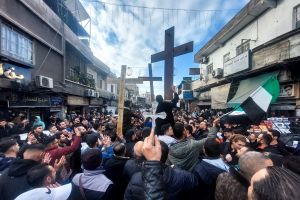
One of the most notable attacks on the Nigerian Christian community in 2025 included the murder of over 200 believers in Benue state in June, with a Catholic charity calling it the "single worst atrocity" in a region that has become known for communal attacks.
In the lead-up to his Truth Social announcement, Trump faced mounting pressure from members of U.S. Congress and Christian rights groups to label Nigeria a CPC under the International Religious Freedom Act, the U.S.' top designation for religious freedom violators, which can carry potential diplomatic burdens, such as sanctions.
Although some human rights advocates say that what is happening to Christians in Nigeria, particularly the Middle Belt, meets the standard for genocide, the Nigerian government has pushed back on such claims, saying the violence is not inherently religious and emanates from decades-old farmer-herder clashes. The government has strongly rejected claims of a genocide, but has also faced allegations that it has not acted adequately to protect its citizens from radicalized groups.
Earlier this month, the U.S. State Department announced that it will restrict visas to Nigerians known to have supported or participated in alleged violations of religious freedom.
"The United States is taking decisive action in response to the atrocities and violence against Christians in Nigeria and around the world," said U.S. Secretary of State Marco Rubio in a statement posted on X.
The U.S. diplomatic pressure on Nigeria may already have prompted Nigerian government action. In late November, amid a series of kidnappings of school children, Nigerian President Bola Tinubu ordered the recruitment of 20,000 new police officers on top of the 30,000 new officers previously approved. He also approved the recruitment of forest guards under the Department of State Services and said state-run security outfits would receive federal support.
Samuel Smith contributed to this report.