The Christian Post's top 10 news stories of 2025 (part 1)

6. Armenia arrests church leaders, reaches peace deal with Azerbaijan
It was a historic year of sorts for the world’s first Christian nation, Armenia, as it signed a peace agreement and a memorandum of understanding amid decades of territorial conflict with neighboring Azerbaijan. The country also saw domestic political tensions boil over into a series of controversial arrests of Apostolic Church leaders and critics of Prime Minister Nikol Pashinyan.
The Aug. 8 peace agreement was signed at the White House, a supposed symbolic end to the conflict over the Nagorno-Karabakh region, which ethnic Armenians predominantly inhabited until more than 120,000 were pushed out of their homes by Azerbaijan forces in September 2023.
The framework paves the way for a 20-mile transport corridor to be built through southern Armenia, which would be a major intercontinental trade route connecting Azerbaijan and Turkey. The project would be managed by the United States, which would provide Armenia with de facto security as long as the U.S. has a financial stake in the Caucasus region.
While the peace agreement could take months or even years to finalize, fears for many Armenians of a full-scale invasion by Azerbaijan appear to have been quelled when The Christian Post visited the country in September as part of a delegation trip sponsored by the U.S.-based advocacy group Save Armenia.
However, the deal is not without its critics, including leaders from the Artsakh government in exile, who are angered that the peace framework, as announced, doesn’t include a right to return for refugees struggling to socially integrate in Armenia, nor the release of nearly two dozen Artsakh Armenians held captive in Baku. For many, there is also skepticism that Azerbaijan will uphold the agreement over time.
Artsakh government representatives who met with the Save Armenia delegation in September said the Armenian government should have pushed harder for the release of the Artsakh prisoners in Baku to be part of the agreement. They believe Trump would have backed Armenia on such a request if it had been made.
Domestically, Armenia has arrested a series of clergy and others from the Armenian Apostolic Church, who strongly object to Armenia’s land concessions to Azerbaijan.
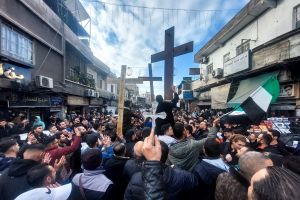
The arrests began with Russian-Armenian businessman Samvel Karapetyan in June, a key philanthropist who spoke in defense of the church when a reporter asked for his opinion. His arrest sparked demonstrations calling for his release.
Days later in June, Archbishop Bagrat Galstanyan, who led an opposition movement called Sacred Struggle and announced a run for prime minister, was arrested and charged with orchestrating a plot to overthrow the government. Advocates say the charges against Galstanyan are based on misleading, cropped audio that was initially released to the public without full context.
Bishop Mkrtich Proshyan of the Diocese of Aragatsotn and 12 clergymen were arrested in October. The bishop was charged with coercing citizens to participate in public gatherings, obstructing electoral rights, and misusing his office to commit large-scale theft. The church called the charges a “malicious intent to hinder the normal activities of the church.”
Last week, Armenia arrested Archbishop Arshak Khachatryan on charges that he planted drugs on people protesting Catholicos Karekin II in 2018. The church labeled Khachatryan’s arrest politically motivated and called for his release, Reuters reports.
The Armenian Apostolic Church dates back to the fourth century and is constitutionally independent from the state. Pashinyan has been highly critical of church leadership, accusing the Catholicos of breaking his celibacy vow and also calling for his replacement. He even vowed to launch a "Coordinating Group" to oversee an election of a new church leader.
Religious freedom advocates told congressional staffers last month on Capitol Hill that Pashinyan’s actions toward church leadership overstep the bounds of church-state separation and are effectively silencing clergy who are now afraid of government reprisal. Additionally, they believe his actions could threaten the effectiveness of any new relationship Armenia may have with the U.S.
Samuel Smith contributed to this report.